
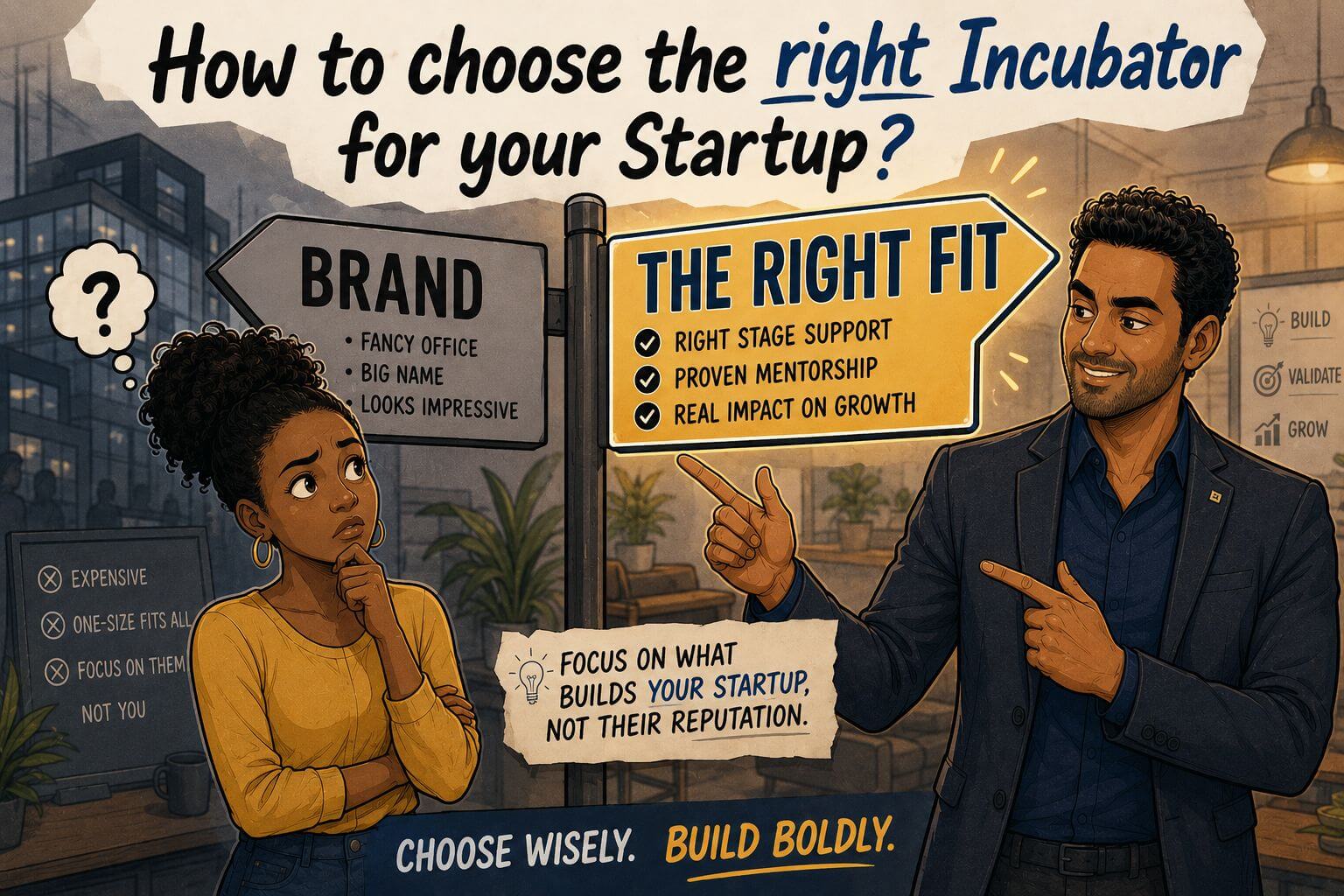

Here’s a truth that most incubator marketing won’t tell you: the best incubator for your friend might be the worst possible choice for you.
I’ve spent over a decade working with founders across every stage of the startup lifecycle. I’ve watched brilliant ideas die inside the wrong program. I’ve seen mediocre concepts turn into real businesses because the founder found the right environment. The difference between those two outcomes rarely comes down to the founder’s talent or the quality of the idea. It comes down to the right fit.
Here’s the thing nobody tells you about startup incubators: they are not commodities. They are not interchangeable.
Each program has a specific design philosophy, stage focus, sector strength, and culture. When you pick one without understanding how it maps to your specific situation, you’re not just wasting application time. You’re betting months of your life and potentially giving away equity for something that could actually hurt your progress.
Most founders evaluate incubators the same way they evaluate colleges. They look at the brand name. They look at the Instagram photos of happy founders in co-working spaces. They look at the list of investors who have come to demo days. And then they apply to the one with the most impressive-sounding website.
That approach is exactly backwards.
The 10 factors I’m going to walk you through in this article form a decision system. Not a listicle. Not generic advice. A system that accounts for your stage, your background, your industry, your personality, and your goals. By the end of this article, you’ll know exactly what questions to ask in every program interview, what red flags to look for, and how to score each program so you can compare them on actual data instead of gut feeling.
Whether you’re a black founder in Detroit building a logistics startup, a Latina founder in Houston launching a healthtech platform, an Asian-American immigrant in Atlanta trying to break into fintech, or a career-switcher in Columbus Ohio leaving corporate to build something of your own – the framework here applies to you.
Let’s get into it.
In this post, we'll cover:
- 1 Why Most Founders Choose Wrong
- 2 Factor 1: Mentor Quality Over Mentor Quantity
- 3 Factor 2: Stage Alignment
- 4 Factor 3: Format Fit – Remote, Local, or Hybrid
- 5 Factor 4: Methodology – Do They Have One?
- 6 Factor 5: Terms and Transparency
- 7 Factor 6: Network Depth and Relevance
- 8 Factor 7: Cohort Design and Peer Quality
- 9 Factor 8: Post-Program Support
- 10 Factor 9: Industry or Vertical Focus
- 11 Factor 10: The “Vibe Check” – Culture Fit
- 12 Decision Framework: The 10-Factor Scorecard
- 13 The Truth – Most Incubators Are Not Built for Non-Tech Founders
- 14 FAQ
- 14.1 What’s the difference between an incubator and accelerator?
- 14.2 How much equity do incubators typically take?
- 14.3 Can I apply to multiple incubators at once?
- 14.4 What if I don’t get into any program?
- 14.5 Is Y Combinator an incubator?
- 14.6 Are incubators worth it for non-tech founders?
- 14.7 How long do incubator programs typically last?
- 14.8 What’s the best incubator for a complete beginner?
- 14.9 How do I know if an incubator is a scam?
- 14.10 Should I relocate for an incubator program?
- 15 Conclusion
Why Most Founders Choose Wrong

I always say to our founders at StartupGuru: the biggest mistake you can make is treating an incubator application like a college application.
You’re not trying to get into the most prestigious program.
You’re trying to get into the program that will actually help you build a business.
The way most founders approach incubator selection is broken in three specific ways. Let me walk through each one, because recognizing these patterns in yourself is the first step to making a better decision.
The Brand Trap
Founders chase brand names without asking a single question about fit. I see it constantly. A founder hears about Y Combinator or Techstars and immediately fixates on getting in. They spend weeks crafting the perfect application. They obsess over demo day prep. They imagine the investor attention that comes with the brand.
But they never ask the most important question: does this program solve my actual problem right now?
Here’s a hard truth. Y Combinator is one of the greatest institutions in startup history. It has produced some of the most valuable companies on the planet. But Y Combinator is designed for companies that already have traction. The application literally asks for your revenue numbers, your growth rate, your user metrics. If you’re pre-revenue with just an idea, you’re applying to the wrong program.
I’ve met founders who spent six months trying to get into brand-name programs while ignoring local incubators that could have given them exactly what they needed at their stage. The brand-name program would have rejected them anyway – because they were early-stage. And even if they got in, the program would have been optimized for growth, not validation.
The brand trap is seductive because brand-name programs offer status. They offer a signal to investors, to customers, to employees. But status only matters if the program actually helps you build a business worth signaling about. A brand-name incubator or accelerator that pushes you to raise money before you have product-market fit doesn’t help you. It hurts you.
The Funding Fallacy
The second mistake founders make is optimizing for funding access when they haven’t validated demand yet.
Here’s how the thinking goes: “I need money to build my product. Incubators connect you to investors. Therefore, I should join an incubator that has the best investor network.”
This logic sounds reasonable, but it has a fatal flaw. It assumes that raising money is the right next step for your business. For most pre-revenue startups, raising money is the wrong next step.
Let me tell you about a founder named Andre from Atlanta Georgia. Andre had an idea for a B2B platform serving independent auto repair shops. He had spent 10 years working in the auto repair industry. He knew the pain points intimately. He applied to and got into a well-known accelerator program that boasted an impressive investor network.
The program pushed him toward fundraising from day one. He spent weeks perfecting his pitch deck, practicing his demo, building financial projections for businesses that didn’t exist yet. He raised a small pre-seed round from an angel investor he met through the program.
Six months later, he had built a product that auto repair shops didn’t want. He had spent $80,000 of investor money on development and marketing. His product solved a problem that sounded good in theory but wasn’t painful enough for shop owners to actually pay for. He had 12 shops using a free trial and zero paying customers.
Andre’s mistake wasn’t that he built the wrong product. His mistake was that he raised money before validating demand. The funding gave him the resources to build the wrong thing faster. He would have been far better off spending three months talking to 100 auto repair shop owners, identifying the real pain point, and building the minimum sellable solution to test in the market.
The Comparison Trap
The third mistake is choosing based on what worked for other founders with different backgrounds.
A white male Stanford graduate who is 24 years old with a technical background and a network in Silicon Valley has a completely different startup experience than a 38-year-old black woman in Memphis Tennessee who is building a logistics company with no technical co-founder and no Silicon Valley connections. The program that worked for the first founder might be the worst possible fit for the second.
Yet founders constantly make decisions based on testimonials from people who have nothing in common with them. They read a Medium post from a Stanford CS graduate who “crushed it” at a particular accelerator, and they decide that’s the program for them. They don’t stop to ask: does this person’s experience match my reality?
The answer is almost always no.
Your background determines what you need from an incubator. If you’re a non-technical founder, you need customer discovery frameworks and sales methodology more than you need pitch coaching. If you’re a founder without a network, you need targeted introductions more than you need general mentorship. If you’re a founder with family obligations, you need a format that respects your schedule.
The best incubator for the 24-year-old Stanford grad is not the best incubator for you. Stop comparing your path to theirs.
The data backs this up. According to CB Insights, 42 percent of startups fail because there’s no market need for their product. That’s not a fundraising problem. That’s not a technology problem. That’s a validation problem. And most incubators — especially the famous ones — are not designed to solve validation problems.
Think about what most incubators optimize for. They optimize for demo day. They optimize for investor presentation. They optimize for the pitch. That makes perfect sense if you already have a product, you already have customers, and you need capital to scale. But what if you’re pre-revenue? What if you haven’t even figured out who your customer is?
Most advice says “get into the best incubator you can.” Here’s why that’s wrong: the “best” incubator for someone who has traction is actively bad for someone who doesn’t.
I worked with a founder named James from Austin Texas. James had a B2B SaaS idea for independent insurance brokers. He was smart, he had domain expertise from 12 years in the insurance industry, and he had savings to live on for about 18 months. He got into a top-tier accelerator program. Sounded great. But the program was built for companies with at least $50,000 in monthly recurring revenue who needed to accelerate growth. James didn’t even have a pilot customer yet. He spent the entire program frantically trying to catch up to peers who were 18 months ahead of him. He came out of the program without a demo day win and without the product-market fit he desperately needed. He burned through his savings. He eventually shut the company down.
That’s not because James wasn’t good enough. It’s because he chose the wrong program for his stage.
Then there’s the funding trap. Founders assume incubators are about access to capital. And yes, many programs do provide funding or connect you to investors. But here’s the question nobody asks: do you actually need funding right now?
If you haven’t validated that anyone will pay for your solution, raising money is the worst thing you can do. It commits you to a trajectory before you’ve proven the fundamentals. You take the check, you start spending on engineering and marketing, and six months later you realize nobody wants what you’re building. Now you’ve wasted investor money, damaged your reputation, and lost the time you could have spent actually talking to customers.
Sell first. Then build. Then raise. That’s the formula I teach every single founder who walks through our doors at StartupGuru. If an incubator’s program is designed around raising money before you’ve sold anything, it’s the wrong program for you at this stage.
The takeaway: The biggest predictor of whether you’ll benefit from an incubator is not the incubator’s brand. It’s the alignment between what the program delivers and what you actually need right now.
Factor 1: Mentor Quality Over Mentor Quantity

I’m going to tell you something that might surprise you: most incubator mentor lists are marketing.
Here’s how it works. The program reaches out to 300 successful founders, executives, and investors. Maybe 50 agree to be listed as mentors. The program puts all 50 names on the website with impressive bios and logos. You look at that list and think “wow, I’ll have access to all these people.”
The reality? You might get one 30-minute office hours slot with a partner-track consultant who has never started a company. You might get a group workshop where someone who raised $50 million in 2015 tells you how they did it — advice that has almost nothing to do with your situation in 2026. You might never hear from most of those 50 names again.
What matters is not how many mentors are listed. What matters is who will actually work with you, how much time they’ll spend, and whether they’ve done what you’re trying to do.
I worked with a founder named Sarah from Detroit Michigan. She was building a platform connecting skilled trades workers with commercial contractors. She interviewed three different incubators. One listed 250 mentors on their website. One listed 80. One listed 30.
She almost chose the one with 250. But I told her to ask each program a specific question: “Can you introduce me to three mentors who have personally built a marketplace or a platform business and who would be willing to meet with me weekly for at least an hour?”
The program with 250 mentors couldn’t name three. The program with 80 named two, but neither was in marketplaces or had ever built a two-sided platform. The program with 30 mentors named three instantly. One had built a successful trades marketplace in Chicago. One had exited a B2B platform for $40 million. One was a current operator scaling a similar business.
Guess which program Sarah chose?
Six months later, the mentor with the Chicago marketplace experience became her de facto co-founder advisor. He introduced her to 14 contractors who became her first customers. He helped her avoid a pricing mistake that would have killed her margins. Without him, she would have spent months learning lessons that he had already learned the hard way.
Here’s what I tell every founder who asks me about evaluating mentor quality. You need to look for three things:
First, operating experience. Not advisory experience. Not consulting experience. The person should have been in the trenches. They should have made payroll. They should have dealt with a co-founder breakup. They should have pivoted. If all their experience is giving advice, they’re not a mentor. They’re a commentator.
Second, sector relevance. A great mentor in B2C SaaS who has never dealt with enterprise sales cycles is not helpful if you’re selling to Fortune 500 procurement departments. A mentor who built a direct-to-consumer brand won’t help you navigate FDA regulations for a healthtech product. You need people who have walked your specific path.
Third, time commitment. Ask the hard question: “How much time will this person actually spend with me?” If the answer is vague — “regular check-ins,” “as needed,” “office hours” — that’s a red flag. You want a concrete answer. Weekly one-hour sessions. Bi-weekly deep dives. Actual structured time.
I always say to our founders at StartupGuru: one relevant operator who meets with you every week is worth more than 100 names on a website.
The takeaway: Ask for three specific mentors who have built in your sector and will commit real time. If the program can’t deliver, move on.
Factor 2: Stage Alignment
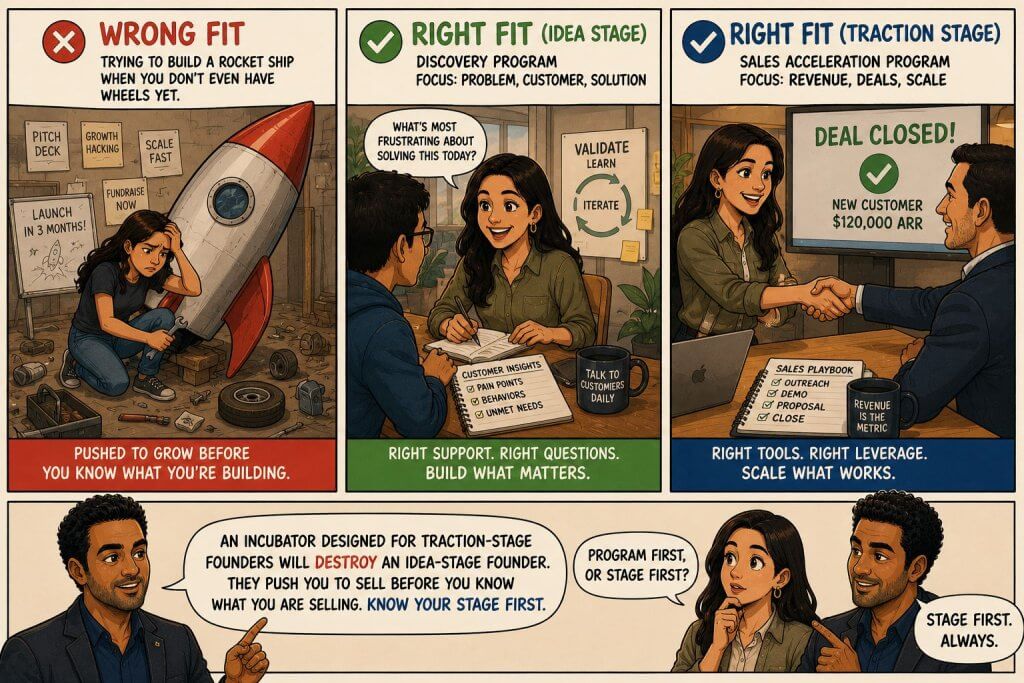
This is the single most important factor. I cannot overstate this.
An incubator designed for idea-stage founders is actively harmful if you already have traction. A program designed for growth-stage companies will chew you up and spit you out if you haven’t validated your idea yet.
Yet most founders completely ignore stage alignment. They apply to programs based on brand recognition, not based on whether the program’s methodology matches where they are.
Let me break this down by stage.
Pre-validation founders need discovery frameworks, not demo days
If you have not yet identified a paying customer — if you are still trying to figure out whether your idea solves a real problem that people will pay for — you need a program that teaches you customer discovery, problem validation, and solution design.
You do not need pitch coaching. You do not need term sheet negotiation workshops. You do not need investor introductions. You need to figure out whether anyone will buy what you’re building.
This is where most incubators fail pre-validation founders. They teach you how to pitch before you have anything real to pitch. They push you toward demo day before you’ve gotten your first “yes” from a customer. The result is a polished presentation for a business that doesn’t exist.
What you actually need is a structured customer discovery framework. You need to learn how to conduct problem interviews that don’t lead the witness. You need to learn how to identify early adopter segments. You need to learn how to prototype a solution without writing a line of code. Understanding what a Minimum Viable Product actually means — and what it doesn’t mean — is critical here. You need the Lean Startup Methodology, not pitch deck design.
Let me give you a specific example of what pre-validation support looks like in practice. A good program for this stage will have you doing at least 50 to 100 customer discovery interviews in the first month. Not surveys. Not focus groups. One-on-one conversations with potential customers where you’re trying to understand their problems, workflows, and pain points. The program should teach you how to structure these conversations to avoid confirmation bias. It should help you identify patterns across interviews. It should force you to articulate a clear problem statement before you even start thinking about solutions.
I worked with a founder named Marcus from Columbus Ohio. Marcus had an idea for a platform that helped small restaurants manage their supply chain. He had spent six months building a prototype before talking to a single restaurant owner. When he finally showed them his prototype, they told him it solved a problem they didn’t have. Their real problem was labor scheduling. Marcus had wasted six months and $15,000 building the wrong thing.
A good pre-validation incubator would have forced Marcus to talk to 50 restaurant owners before writing a line of code. A bad incubator would have patted him on the back and helped him polish his pitch for a product nobody wanted.
The CB Insights data on startup failure backs this up completely. Their research shows that 42 percent of startups fail because there’s no market need. That’s the number one reason for failure. It’s not competition. It’s not team problems. It’s not running out of money. It’s building something nobody wants. And the root cause of building something nobody wants is skipping the validation stage.
When you’re at the pre-validation stage, you need to evaluate incubators differently. Look for programs that emphasize customer development over product development. Look for mentors who have experience conducting discovery interviews and can coach you through the process. Look for a curriculum that spends at least half its time on problem validation before moving to solution design.
Traction-stage founders need sales acceleration and MSP methodology
Once you have paying customers, your needs change dramatically. You no longer need help validating the problem. You need help scaling the solution.
At this stage, you need a program that focuses on revenue growth. You need mentorship around sales processes, pricing strategy, customer acquisition channels, and team building. You need the MSP vs MVP framework — building a Minimum Saleable Product, not just a Minimum Viable Product.
This is where the Sell First > Then Build > Then Raise philosophy becomes critical.
If you have five customers paying you $1,000 each per month, you have $5,000 in monthly recurring revenue. Your goal should be to get to $50,000 MRR before you raise any outside capital. An incubator that helps you do that is worth its weight in equity. An incubator that tells you to go raise money at $5,000 MRR is leading you into a trap.
Why is $50,000 MRR such an important milestone? Because it changes your fundraising dynamics completely. At $5,000 MRR, you’re raising money based on a story and a promise. Investors are betting on your potential, not your results. The valuation will be low. The terms will favor the investor. You’ll give away more equity for less money.
At $50,000 MRR, you have real traction. You can show month-over-month growth. You have customer retention data. You have a unit economics model that’s been validated by real transactions. Investors are now betting on proven results. The valuation will be higher. The terms will favor you. You give away less equity for more money.
A founder named Jessica from Atlanta Georgia came to us with exactly this situation. She had a B2B compliance software product with 12 customers paying $800 per month. Total MRR: $9,600. She was applying to incubators and every one of them was telling her she needed to raise a seed round. They wanted to prep her for investor meetings.
I told her to ignore every investor conversation for the next six months and focus entirely on getting to $50,000 MRR. She did. She hired a part-time salesperson. She optimized her pricing. She added two features that her existing customers specifically requested. She didn’t raise a dollar. And 11 months later, she crossed $60,000 MRR.
Then she raised a seed round at a valuation that was 3x what it would have been at $9,600 MRR. She gave away less equity for more money. And because she had proven her unit economics, investors competed to invest in her round. She had leverage for the first time in her founder journey.
That’s the power of stage-appropriate support.
For traction-stage founders, the ideal incubator focuses on sales acceleration. It should have mentors who have built sales processes from scratch. It should teach you how to build a repeatable customer acquisition channel. It should help you analyze your unit economics and identify the most efficient growth levers. It should push you toward revenue milestones, not fundraising milestones.
Fundraising-stage founders need investor access and deal terms guidance
If you already have significant revenue and you’re ready to raise institutional capital, your incubator needs are different again. Now you need investor introductions, pitch practice, term sheet negotiation support, and help building your data room.
At this stage, brand-name programs actually matter more because investors pay attention to signals. A Techstars alumni logo on your pitch deck signals to investors that you’ve been vetted. That signal has real value when you’re competing for limited attention spans.
But even at this stage, you need to be careful. Some programs take too much equity for the value they provide. Some programs will push you toward their own investor networks rather than finding the best fit for your business. Some programs have deal terms that favor the program over the founder.
The key question to ask at this stage is simple: “Can you show me the term sheets that your last three cohorts signed?” If the program won’t share that data, assume the worst.
The takeaway: Before you apply to any program, write down exactly what stage you’re at. Then ask: does this program have a track record of helping founders at my stage? If not, keep looking.
Factor 3: Format Fit – Remote, Local, or Hybrid
Here’s a question that seems simple but most founders get wrong: do you want to work in person, remotely, or a mix of both?
I’ve written extensively about the differences between remote and local incubators, and this article is the perfect companion to that discussion. The format you choose affects everything – your daily routine, the quality of relationships you build, the type of mentors you access, and the kind of support you receive.
Let me give you the straight truth about each format.
Remote programs: maximum access, minimum depth
Remote incubators give you access to the best mentors from anywhere in the world. You’re not limited by geography. You can participate in a Silicon Valley program while living in Tulsa Oklahoma. That’s a huge advantage for founders in Tier 2 and Tier 3 US cities who can’t afford to relocate.
But remote programs have a real downside: shallow relationships. It’s hard to build the kind of deep trust and accountability that comes from working alongside people in the same room. When you’re on Zoom calls and Slack channels, you miss the spontaneous conversations, the after-hours problem-solving, the hallway networking that produces real breakthroughs.
I’ve seen this pattern play out many times. A founder joins a remote program with 30 other companies. The first week is exciting – lots of Slack messages, lots of Zoom intros. By week four, the Slack channels are quiet. The Zoom attendance is dropping. People are busy building their businesses, and the remote community becomes background noise.
Remote works best for founders who are self-motivated, already have some traction, and need specific expertise rather than general support. It works worst for early-stage founders who need intense hands-on guidance and peer accountability.
If you’re considering a remote program, here’s what to look for. First, structured accountability. Does the program have regular check-ins with mentors who hold you accountable for weekly goals? Second, intentional community building. Does the program create structured opportunities for peer interaction, or do they just set up a Slack channel and hope for the best? Third, time zone consideration. If the program is based in a different time zone, will you be attending calls at inconvenient hours for the entire duration?
Local programs: maximum depth, limited access
Local incubators let you work alongside other founders in the same physical space. You build real relationships. You develop a support network. You hold each other accountable. If you’re the kind of person who needs community to stay motivated, local is probably right for you.
The tradeoff is access. A local incubator in Dayton Ohio has a different mentor pool than a local incubator in San Francisco. The investors who show up to demo days are different. The network effects are smaller.
But there’s another dimension to this that most founders don’t consider. Local programs give you geographic roots. If your business is tied to a specific local economy – a restaurant-tech platform serving Columbus, a logistics company serving the Port of Savannah, a construction-tech platform serving the Houston building boom – a local program connects you to the specific networks you need.
I worked with a founder named Lamar from Memphis Tennessee who was building a logistics platform for independent truckers operating out of the Memphis distribution hub. He joined a local incubator in Memphis. The program connected him with logistics executives at FedEx, with the Memphis Regional Chamber, and with investors who specifically focused on supply chain startups in the Southeast. A remote program could never have provided that depth of local connection.
Local works best for founders who need community, thrive on in-person interaction, and are building businesses that are connected to their local economy. It works worst for founders who need specialized mentors or investors that don’t exist in their geography.
If you’re considering a local program, evaluate the local ecosystem honestly. Is there enough startup activity in your city to sustain a strong mentor network? Are there local investors who fund companies at your stage? Is the local talent pool deep enough for hiring?
Hybrid programs: the best of both, done right
The best programs I’ve seen in 2026 are hybrid. They combine intense in-person residencies with ongoing remote support. You get the depth of in-person relationships during key moments – the residency periods – and the breadth of remote access for ongoing mentorship.
The key to a good hybrid program is intentionality. It’s not enough to have a few Zoom calls and occasional in-person events. A well-designed hybrid program has specific in-person moments that are designed to build trust and momentum. The remote periods are structured with clear goals, regular check-ins, and accountability systems.
The best hybrid programs I’ve seen use a structure like this: a one-week in-person kickoff to build relationships and set direction, followed by 8-12 weeks of structured remote work with weekly group check-ins and individual mentor sessions, capped by a one-week in-person finale for presentations and networking.
This structure gives you the depth of in-person connection without requiring you to relocate for three months. It’s usually the best option for founders who have family or job obligations but still want the benefits of an intense program.
A quick quiz to help you decide
Answer these questions honestly:
Do you work better alone or surrounded by people? If you need people around you to stay focused, prioritize local or hybrid. If you’re disciplined and can work from anywhere, remote might work.
Can you afford to relocate for 3-6 months? If yes, consider local programs in startup hubs. If no, remote or your local incubator is the answer.
Is your business tied to a specific geography? If you’re building a restaurant-tech platform that needs to integrate with local POS systems, local matters. If you’re building a global B2B SaaS product, geography matters less.
Do you have family obligations that prevent travel? If yes, remote or local only.
Does your personality thrive on deep in-person relationships or broad networks? If you prefer 5 deep relationships over 50 surface-level connections, local is better. If you want a wide network, remote or hybrid.
The takeaway: Don’t pick a format because it sounds impressive or because your friend did it. Pick the format that fits your personality, your obligations, and your stage.
Factor 4: Methodology – Do They Have One?
Most incubators have a workspace and a schedule. The best ones have a system.
Here’s the difference. A generic incubator will give you access to a co-working space, a calendar of workshops, and a list of mentors you can book for office hours. You show up, attend the sessions, book the meetings, and figure out the rest on your own.
A great incubator has a methodology. It has a clear, documented process for taking a founder from point A to point B. It doesn’t leave the most important work to chance.
When I evaluate incubators for our founders at StartupGuru, I ask one question that cuts through all the marketing: “What is your exact process for taking a founder from idea to first paying customer?”
The answers tell me everything.
If the answer is vague – “we provide mentorship and resources,” “we help founders iterate,” “we have a proven framework” – that’s a red flag. Those are non-answers.
If the answer is specific – “we start with 6 weeks of customer discovery interviews using a structured problem-validation framework, then 4 weeks of solution prototyping, then 8 weeks of MSP development with weekly sales targets” – that’s a green flag.
A founder named Michael from Houston Texas came to me after spending four months in a well-known incubator program. He was frustrated. He had attended great workshops. He had met interesting people. But his business hadn’t progressed. When I asked him what the program’s methodology was, he couldn’t describe it. There wasn’t one. It was a collection of activities without a coherent system.
Michael’s situation is extremely common. Incubators look impressive on the surface, but when you dig into what they actually do day-to-day, there’s no underlying logic. No progression from one stage to the next. No clear milestones. No system for deciding what to work on next.
A good methodology should help you:
First, identify and validate a real problem worth solving. Not an interesting problem. A painful problem that people will pay to solve.
Second, design a solution that addresses the problem without overbuilding. This is where the MSP vs MVP distinction matters. Most founders build too much too fast. A good methodology forces you to build the minimum sellable version.
Third, find and close your first paying customers. Not beta users. Not people who say “that’s interesting.” Paying customers.
Fourth, iterate based on real feedback. Not what people say in interviews, but what they do with their wallets.
The Lean Startup Methodology provides a great foundation for this. Build-Measure-Learn is a real loop, not a buzzword. But even Lean Startup needs to be operationalized into a specific program structure.
I always say to our founders at StartupGuru: if you ask about methodology and the program director can’t give you a clear, step-by-step answer, assume there is no methodology. And without a methodology, you’re just paying for a co-working space with occasional office hours.
The takeaway: Ask the methodology question before you apply. A clear answer means they’ve thought about how founders actually progress. A vague answer means they haven’t.
Factor 5: Terms and Transparency
Let’s talk about money.
Incubators charge for their services in different ways. Some take equity. Some charge a program fee. Some do both. Some are free. And the terms vary wildly.
Understanding Equity vs Fee Models
The standard model for top-tier programs is equity. Y Combinator takes 7 percent for $500,000. Techstars typically takes 6 to 9 percent for $100,000 to $120,000. These are well-known deals with published terms, which is exactly what you should look for.
But many smaller incubators take equity without offering any real capital in return. They take 5 to 10 percent of your company in exchange for “access to mentorship and resources.” That’s a terrible deal if the mentorship isn’t worth it.
Let me be direct: giving away equity is expensive. If your company becomes worth $10 million, 5 percent is $500,000. If your company becomes worth $50 million, 5 percent is $2.5 million. You should only give away equity when the value you receive in return is worth at least that much.
The alternative is a fee-based model. The program charges you tuition, typically between $2,000 and $15,000, and takes no equity. This is cheaper in the long run if your company succeeds, but it requires cash upfront – something many early-stage founders don’t have.
There’s also the hybrid model: a smaller equity percentage plus a reduced fee. This can be a good middle ground.
Which model is right for you? It depends on three factors.
First, how much cash do you have? If you have $20,000 in savings and a fee-based program costs $18,000, that’s a big hit to your runway. An equity-based program that requires less cash upfront might be more practical even if it’s more expensive in the long run.
Second, how confident are you in your company’s eventual valuation? If you believe your company will be worth $100 million, giving away 5 percent is a $5 million cost. That’s a lot of money. If you’re less certain, the equity cost might be worth the risk reduction.
Third, what is the program actually providing beyond access? If the program is giving you a cash investment, the equity makes sense – you’re getting something concrete in return. If the program is taking equity for mentorship only, you need to be very confident in the mentorship quality.
Here’s a rule of thumb I share with founders at StartupGuru: if a program takes more than 5 percent equity without providing at least $50,000 in cash, the mentorship and network better be extraordinary. Most programs charging that much equity without a cash component are overpriced. You’d be better off using that equity to hire a part-time advisor or sales consultant who has specific expertise in your industry.
What Good Transparency Looks Like
A program that is confident in its value will be transparent about its outcomes. I’m talking about:
The Y Combinator standard deal is a great example of transparency. They publish their terms, their investment amount, and what they offer. You know exactly what you’re getting into.
Red Flags
Watch out for these warning signs:
Vague testimonials. “This program changed my life” means nothing. “We went from zero to $100K ARR during the program” means everything.
No published data. If they won’t tell you their graduation rates, success rates, or average outcomes, assume they’re hiding bad numbers.
Pressure to sign quickly. “The offer expires in 48 hours” is a sales tactic, not a reflection of actual demand. Legitimate programs give you time to evaluate.
Equity demands without capital. If they want 10 percent of your company and they’re not giving you any cash, you’d better be getting extraordinary value from mentorship and network access.
Non-standard legal terms. Have a lawyer review the agreement. If the program has unusual vesting schedules, repurchase rights, or control provisions, those are red flags.
The CB Insights startup failure data shows that running out of cash is the second most common reason startups fail. Don’t make a bad deal that hastens that outcome.
The takeaway: Demand transparency. If a program won’t share specific outcomes data, they’re either hiding something or they don’t track it. Both are bad signs.
Factor 6: Network Depth and Relevance
Every incubator brags about its network. “We have connections to 500 investors.” “Our mentoring network spans 20 industries.” “We’re plugged into the entire startup ecosystem.”
But here’s the question that matters: is their network relevant to YOU?
A deep network in consumer SaaS is useless if you’re building industrial hardware. A strong presence in the New York tech scene won’t help if your customers are all in the Midwest. An investor base that focuses on Series A deals won’t help if you’re raising a pre-seed round.
When I help founders evaluate network quality, I ask them to map the network against their specific needs:
Where are the investors who invest in your sector? If you’re building a healthtech company, you need investors who understand healthcare regulations, reimbursement models, and clinical workflows. A generalist investor who funds e-commerce and SaaS companies won’t have the domain knowledge to evaluate your deal properly.
Are the mentors in your specific industry? Not adjacent industries. Not “close enough.” Your exact industry. If you’re building a logistics platform for independent truckers, you need mentors who have built logistics platforms for independent truckers.
Is the geographic coverage relevant? If you’re building a company in the Southeast, you need investors and mentors who understand the Southeast market. The Bay Area is great for Bay Area companies. It’s less relevant for Birmingham Alabama.
One of the founders we received application from last year, Priya from Chicago Illinois, was building an edtech platform for adult learners. She got into a prestigious program in Boston. The network was impressive – lots of investors and mentors in the Boston ecosystem. But Priya’s target market was adult learners in community colleges across the Midwest. The Boston network had no connections to that world. She spent the entire program trying to get introductions to people who didn’t exist in the program’s network.
A smaller incubator based in Chicago would have been far more valuable for her. The Chicago program had deep connections with Midwestern community colleges, workforce development organizations, and edtech investors who specialized in adult learning.
The lesson is simple: a network is only valuable if it’s relevant to YOUR business. A general network is better than no network. But a targeted, relevant network is better than a general network.
You can also use the Startup Incubator vs Accelerator distinction to think about this. Incubators typically have broader, earlier-stage networks. Accelerators tend to have more investor-heavy networks. Think about which one you need based on where you are in the startup funding stages.
The takeaway: Don’t ask “how big is your network?” Ask “who in your network is relevant to my specific business?”
Factor 7: Cohort Design and Peer Quality
Here’s something I’ve observed after working with hundreds of founders: your peers in an incubator program will influence your trajectory as much as the mentors will.
Think about it. You’re going to spend three to six months working alongside these people. You’ll share war stories. You’ll celebrate wins and commiserate over losses. You’ll hold each other accountable. You’ll challenge each other’s assumptions. You’ll make connections that last well beyond the program.
The quality of that peer group matters enormously.
A founder named David from Austin Texas went through a program where the cohort was highly selective – they accepted 12 companies out of 800 applicants. The peer quality was extraordinary. David was surrounded by founders who had already closed six-figure contracts, who had built teams, who understood the game at a high level. David was the weakest founder in the cohort, and that was the best thing that ever happened to him. He learned more from his peers than from any mentor.
A founder named Rachel from Nashville Tennessee went through a program with a large cohort – 60 companies, very low selectivity. The quality was mixed. Some founders were serious. Many were hobbyists. Rachel spent most of her time trying to filter out the noise. She made a few good connections, but the overall experience was diluted.
The lesson is that cohort selectivity matters. Programs with rigorous application processes tend to attract more serious founders. Programs that let anyone in create environments where you have to work harder to find the right peers.
But selectivity isn’t the only factor. You also need stage alignment within the cohort. If you’re at $50,000 MRR and everyone else is at zero, you’ll feel like you’re in a different league. That can be isolating. Conversely, if you’re at zero and everyone else has traction, you might feel behind and discouraged.
The ideal cohort has a range of stages within a reasonable bandwidth. Some founders ahead of you who you can learn from. Some founders at your level who you can grow with. Some founders slightly behind you who you can help — and teaching others is one of the best ways to solidify your own learning.
The takeaway: Ask about cohort size, selectivity rate, and the stage range of accepted founders. A tight, selective cohort of 10-20 companies is usually better than a loose, unfiltered cohort of 50+.
Factor 8: Post-Program Support
What happens after you graduate?
This is a question that almost nobody asks, and it’s one of the most important ones. Many incubators are transactional. You finish the program, you attend demo day, and then you’re on your own. The program moves on to the next cohort. Your emails get answered less frequently. Your mentors become harder to reach.
The best incubators have active alumni communities that generate ongoing value. Alumni hire each other. Alumni invest in each other. Alumni introduce each other to customers and partners. Alumni come back to mentor current cohorts. The network compounds over time.
I’ve seen the power of this firsthand. Another founder, Kevin from Denver Colorado, went through an incubator in 2023. He built a solid B2B software company for commercial real estate brokers. In 2025, when he was ready to raise his Series A, three of his warmest investor introductions came from other alumni of the program – people he had never met during his cohort but who were part of the broader alumni network. One of those introductions led to his lead investor. Another alumni became his first enterprise customer. The alumni network generated more value for Kevin in year three of his company than the program itself generated during the cohort.
That’s the kind of compounding value that only comes from a program that invests in its alumni community long after the program ends.
I also saw the opposite with a founder named Derrick from Kansas City Missouri. He joined a program that had strong in-cohort support but zero alumni infrastructure. After graduation, the Slack channel went silent. The program director stopped responding to emails. The alumni directory on their website listed 300 graduates with no contact information or context. Derrick needed introductions to specific enterprise buyers in the manufacturing space. The program had graduated multiple founders who had built manufacturing software companies, but there was no mechanism to connect with them. The network was dead.
Derrick’s experience is far more common than Kevin’s. Most incubators treat the cohort as the product and alumni as marketing collateral. They want your success story for their website, but they don’t want to invest in the infrastructure that keeps the alumni community alive.
When you’re evaluating post-program support, ask these specific questions:
Do alumni have ongoing access to mentors? Some programs let alumni book office hours with mentors indefinitely. Some cut off access after graduation day. This is easy to verify – ask a recent graduate when the last time they booked a mentor session was.
Is there an active alumni community? Look beyond the directory. Ask about alumni events, annual gatherings, ongoing Slack or Discord activity. A dormant alumni list with 500 names is a list, not a community. An active group of 50 alumni who regularly share opportunities and introductions is a community.
Do alumni hire from or invest in each other? This is the strongest signal of a healthy alumni network. When alumni actively do business with each other, it means the network has real economic value. Ask for specific examples of alumni-to-alumni deals that happened in the last year.
What percentage of alumni are still active in the community? If only 5 percent of alumni stay engaged after two years, the network is weak. If 30 to 40 percent or more are still active, it’s strong.
Does the program provide follow-on funding support? Some programs have dedicated follow-on funds for alumni. Others have structured relationships with later-stage investors who trust the program’s filter. Some even have alumni-led funds that invest in subsequent cohorts. These structures indicate a long-term commitment to founder success.
The takeaway: An incubator that treats you as a transaction will forget you the day you graduate. An incubator that treats you as a long-term relationship will compound in value for years.
Factor 9: Industry or Vertical Focus
Generalist vs specialist. Which is better?
The answer, as with most things in startup life, is “it depends.”
Generalist incubators expose you to a wide range of business models, industries, and challenges. You might be building a medtech device and your cohort peer is building a restaurant POS system. That diversity can be valuable – it forces you to think about your business from different angles. You might learn about subscription pricing from a SaaS founder that would never occur to you in a healthtech context.
But generalist programs also dilute the industry-specific expertise available to you. The mentors are generalists. The workshops cover universal topics like fundraising and hiring. Nobody in the program deeply understands the specific regulatory, technical, or market challenges of your industry.
Specialist incubators are the opposite. They focus on one vertical – fintech, healthtech, climate tech, enterprise SaaS, or whatever it might be. Everyone in the program understands your industry. The mentors have deep domain expertise. The workshops cover industry-specific topics. The investor network is concentrated in your space.
For non-tech founders, a vertical-specific program often provides deeper value. Here’s why: if you’re a non-technical founder breaking into an industry, you have a lot of domain-specific learning to do. A generalist program might teach you how to build a pitch deck. A specialist program teaches you how to navigate FDA approval, or how to sell to school districts, or how to structure a marketplace for independent contractors.
Tony from Atlanta Georgia was building a fintech product for immigrant communities. He joined a fintech-only incubator. The program’s mentors included former regulators from the CFPB, a founder who had built a successful remittance business, and a banking executive who understood compliance for underbanked populations. Tony’s learning curve was dramatically compressed because the entire program was designed around his specific challenges.
If he had joined a generalist program, he would have spent weeks on topics that didn’t apply to him while missing the regulatory guidance he desperately needed.
That said, there are times when a generalist program is better. If you’re building something genuinely novel that doesn’t fit neatly into an existing category, a generalist program might find you more relevant mentors. If you benefit from cross-industry inspiration – seeing how e-commerce growth tactics might apply to your B2B product – the diversity is valuable.
The takeaway: Specialist programs are usually better for non-tech founders entering regulated or complex industries. Generalist programs can be better for novel business models or founders who benefit from cross-pollination.
Factor 10: The “Vibe Check” – Culture Fit

This is the factor that most founders dismiss as soft. But I’ve seen it sink more incubator experiences than any misalignment on stage or sector.
Culture matters because you’re going to spend 12 to 20 weeks in a high-pressure environment with these people. If the culture doesn’t fit your personality, you’ll be miserable. And misery kills productivity.
Competition vs Collaboration
Some incubators are intensely competitive. They rank founders. They have leaderboards. They create a “survival of the fittest” environment where only the strongest companies get attention. This works for some founders — the competitive ones who thrive on pressure.
For others, it’s toxic. They need a collaborative environment where founders help each other, share insights, and celebrate each other’s wins. A competitive culture in a collaborative founder is a recipe for burnout.
Ask yourself honestly: do you perform better when you’re trying to beat others, or when you’re working together?
Founder-first vs Investor-first
Some programs are designed around what’s best for the founder. They prioritize your learning, your development, and your long-term success – even if it means telling you that you’re not ready to raise money or that you should take a different approach.
Other programs are designed around what’s best for investors. They push you toward demo day whether you’re ready or not. They encourage you to raise money when you should be building revenue. They optimize for outcomes that look good on their marketing materials rather than outcomes that are good for you.
How do you tell the difference? Look at how they talk about their alumni. Do they celebrate the companies that raised the most money, or the ones that built sustainable businesses? Do they brag about their demo day outcomes, or about their low failure rate? The framing tells you everything.
Diversity and inclusion in practice, not marketing
Every program talks about diversity and inclusion. But talk is cheap. Look at their actual cohort composition. Look at who the leadership team is. Look at who the mentors are. Look at who gets funded from their program.
A founder named Jasmine from Houston Texas, – a black woman building a logistics platform, evaluated a program that had glossy diversity statements on their website. But when she looked at the current cohort, out of 30 companies, only two had black founders and none had black female founders. The mentor list was overwhelmingly white and male. The investors who attended demo day were from firms that had poor track records of funding diverse founders.
She chose a smaller program that had a genuinely diverse cohort, diverse mentors, and a track record of black and female founders raising follow-on funding. Her experience was dramatically better because she didn’t have to constantly be the “only one” in the room.
A note for non-tech founders specifically: some incubator cultures can be dismissive of founders who don’t have technical backgrounds. You’ll hear subtle (and not-so-subtle) messages that building a startup requires coding skills, and that non-technical founders are less legitimate. That’s cultural poison.
Find a program that respects the Sell First > Then Build > Then Raise philosophy – a program that understands that business creation is about customers and revenue, not about who can write the most elegant code.
The takeaway: Trust your gut on culture. If something feels off during the interview process, it will feel 10 times worse when you’re in the middle of the program.
Decision Framework: The 10-Factor Scorecard
You’ve read through all 10 factors. Now it’s time to put them to work.
I use a simple scoring system to help founders evaluate incubators objectively. Rate each factor on a scale of 1 to 5, where 1 is “this program fails completely on this factor” and 5 is “this program is exceptional on this factor.”
Here’s how to score each factor:
Factor 1: Mentor Quality (1-5)
Factor 2: Stage Alignment (1-5)
Factor 3: Format Fit (1-5)
Factor 4: Methodology (1-5)
Factor 5: Terms and Transparency (1-5)
Factor 6: Network Relevance (1-5)
Factor 7: Cohort Quality (1-5)
Factor 8: Post-Program Support (1-5)
Factor 9: Industry Focus (1-5)
Factor 10: Culture Fit (1-5)
Now let me show you how to use this.
Create a table like this for every incubator you’re evaluating. You can use a spreadsheet or just paper. The key is to be honest with your scores.
Here’s an example of what your evaluation might look like:
| Factor | Incubator A | Incubator B | Incubator C |
| 1. Mentor Quality | 4 | 3 | 2 |
| 2. Stage Alignment | 2 | 5 | 4 |
| 3. Format Fit | 5 | 3 | 4 |
| 4. Methodology | 3 | 5 | 3 |
| 5. Terms/Transparency | 4 | 4 | 2 |
| 6. Network Relevance | 3 | 4 | 5 |
| 7. Cohort Quality | 4 | 5 | 3 |
| 8. Post-Program | 3 | 4 | 4 |
| 9. Industry Focus | 2 | 3 | 5 |
| 10. Culture Fit | 3 | 5 | 4 |
| Total | 33/50 | 41/50 | 36/50 |
In this example, Incubator B scores 41 out of 50. That’s a strong candidate worth serious consideration. Incubator C scores 36 – borderline but has specific strengths (industry focus) that might make it worth exploring deeper. Incubator A scores 33 – below the threshold. You should think twice.
Anything scoring below 35 out of 50 should make you think twice. Above 40 is worth serious consideration. Between 35 and 40 requires careful thought about which factors matter most for your specific situation.
I always say to our founders at StartupGuru: don’t let a high total score in one program blind you to a specific weakness in a critical factor. If stage alignment is a 2 and that’s the most important factor for you, a total of 40 doesn’t matter. Weight the factors that matter most to your situation.
The takeaway: Use the scorecard. Don’t trust your gut on something this important. Measure, compare, then decide.
The Truth – Most Incubators Are Not Built for Non-Tech Founders
I need to tell you something that most incubators won’t admit: the majority of startup incubator programs are designed by technical founders, for technical founders.
Think about the typical incubator curriculum. It includes sessions on technical architecture, agile development, code review, product engineering. It assumes you have a technical co-founder or can build the product yourself. The mentors are often former CTOs or technical founders. The peer group is full of engineers building the next great API.
If you’re a non-tech founder, and many of the best founders I know are non-tech, this environment can be actively alienating.
You’re constantly reminded that you’re the “business person” in a room full of “builders.”
Your contributions are subtly (or not so subtly) devalued. T
he unspoken message is that the real work happens in code, and your job is to stay out of the way.
This is wrong.
Some of the most successful companies in history were founded by non-technical people. Michael Dell built Dell Computers without being a hardware engineer. Howard Schultz built Starbucks without roasting coffee. Sara Blakely built Spanx without a background in apparel manufacturing.
These founders understood something that many incubators don’t: business creation is about understanding customers, building relationships, and creating value.
Code is a tool, not a strategy.
The problem is structural. Most incubators were founded by technical people who built technical products and now want to help other technical people build technical products. The curriculum naturally reflects their worldview. The mentors are naturally drawn from their network. The program design naturally favors the kind of founder they understand.
If you’re a non-tech founder, this structural bias means you need to be much more discerning in your program selection. You’re swimming against the current. The programs that work for technical founders might work against you.
What non-tech founders actually need
Let me be specific about what non-tech founders should look for in an incubator.
First, customer discovery and validation frameworks that don’t require a prototype. You need to validate demand before you build anything. The Why MVPs Fail article covers this in detail – many founders jump to building before they validate, and that’s a recipe for wasted time and money.
Second, the MSP methodology. A Minimum Saleable Product is about finding something you can sell before you build anything. A sales deck. A concierge service. A manual process that you’ll automate later. The goal is revenue, not features. The MSP vs MVP framework is specifically designed for non-tech founders who don’t want to waste time building software that nobody will buy.
Third, a technical co-founder strategy. Most non-tech founders obsess over finding a technical co-founder. But the data shows that the best time to find a technical co-founder is after you’ve proven demand — not before. When you have paying customers and real revenue, technical talent will be interested in joining you. When you have an idea and nothing else, they won’t. The MVP Development for Non-Technical Founders guide covers how to build without a technical co-founder.
Fourth, sales training from day one. Non-tech founders need to be selling before they’re building.
The Sell First > Then Build > Then Raise framework isn’t optional.
It’s the only way for non-tech founders to build leverage in a market that favors technical teams. When you have revenue, you have options. When you don’t, you’re at the mercy of technical talent who may or may not want to work with you.
Fifth, respect for your non-technical background. The best incubators for non-tech founders don’t treat the lack of technical skills as a deficiency. They treat it as a difference. They recognize that the skills that make a great business builder – empathy, sales ability, strategic thinking, relationship building – are not technical skills. They are human skills.
How to filter for programs that understand non-tech founders
When you’re evaluating incubators as a non-tech founder, ask these specific questions in your interview:
How many of your mentors are non-technical founders who built successful companies? Not former engineers who became founders. People who built companies without writing code themselves. The answer tells you whether the program values the non-tech founder path.
What percentage of your successful alumni are non-technical founders? This tells you whether the program actually works for people like you. A program that claims to support non-tech founders but can’t name successful non-tech alumni is lying.
Does your curriculum include customer discovery and sales methodology as core components, or are they optional extras? They should be the foundation of the program, not afterthoughts.
How do you help non-tech founders find technical talent? The answer should go beyond “network with other founders in the cohort.” Look for programs that have partnerships with technical bootcamps, coding schools, or freelance platforms. Look for programs that teach you how to evaluate technical talent, how to structure technical partnerships, and how to manage technical contractors.
Does your program emphasize building before selling or selling before building? Listen carefully to the answer. If they say “you need a prototype before you can sell,” that’s a red flag for a non-tech founder. If they say “sell first, then build based on what customers tell you,” that’s a green flag.
The takeaway: If the program can’t point to successful non-tech alumni, don’t assume you’ll be the exception. Look for a program that’s specifically designed for your reality.
FAQ
What’s the difference between an incubator and accelerator?
Incubators focus on the earliest stage of a startup’s life — validating the idea, finding product-market fit, building the product. They typically don’t require a functioning product or existing revenue to join. The timeline is usually longer, ranging from 3 to 12 months. The focus is on founder development and business validation.
Accelerators focus on scaling an existing business with traction. They’re shorter (typically 3 months), more intense, and usually end with a demo day where founders pitch to investors. They assume you already have some product-market fit and need help accelerating growth.
Think of it this way: incubators help you find product-market fit. Accelerators help you exploit it. For a deeper breakdown, check out the Startup Incubator vs Accelerator comparison.
The Stripe guide provides a good overview of the structural differences between the two models.
How much equity do incubators typically take?
It varies widely. Top-tier programs like Y Combinator take 7 percent in exchange for a $500,000 investment. Techstars takes 6 to 9 percent for $100,000 to $120,000. Many smaller incubators take between 2 and 10 percent, often in exchange for a smaller cash investment or no cash at all.
Some incubators charge a program fee instead of taking equity, typically between $2,000 and $15,000. Fee-based programs are better for founders who are confident their company will have significant value later. Equity-based programs can be better for founders who need to conserve cash.
The Y Combinator standard deal is a good reference point for understanding what a transparent, standard equity deal looks like.
Here’s my honest advice on equity: if an incubator is taking more than 5 percent of your company and not giving you at least $50,000 in cash, be very skeptical. The equity you give away today is the most expensive equity you will ever give away because it represents the largest potential upside. Make sure you’re getting extraordinary value in return.
Can I apply to multiple incubators at once?
Yes, and you should. Apply to three to five programs that score well on your 10-factor evaluation. Application processes take time, and there’s no penalty for applying to multiple programs simultaneously. If you get accepted to multiple programs, you can use the acceptances as leverage to negotiate terms or simply choose the best fit.
Here’s my specific advice on the application process. Start with the programs that score highest on your scorecard. Apply to those first. Then, as a backup, apply to one or two programs that are slightly easier to get into but still score reasonably well. Don’t put all your eggs in one basket, especially if that basket is a highly selective brand-name program.
If you do get accepted to multiple programs, don’t be afraid to negotiate. Programs sometimes compete for strong founders. If Program A offers you a spot with a fee-based model and Program B offers you a spot with an equity model, you can ask Program A if they would consider a reduced fee, or ask Program B if they would substitute some equity for cash. The worst they can say is no, and the best case is you improve your terms.
What if I don’t get into any program?
This happens more often than you’d think, and it’s not the end of your startup journey. Many successful founders never went through an incubator.
If you don’t get into any program, focus on the fundamentals. Talk to customers. Validate demand. Find your first paying customers. You can follow the MSP methodology on your own. Build revenue. Get to $10,000 in monthly recurring revenue. Then apply to programs again – you’ll be a much stronger candidate with traction.
The How to Validate Your Startup Idea guide can help you do this independently. The What to Consider Before Starting Your Startup article is also useful for building the right foundation.
Remember: incubators are accelerants, not requirements. If you build a business with real traction, the programs will be interested in you. If you don’t have traction, the programs won’t help you as much anyway. Focus on building the business first. Programs will follow.
Is Y Combinator an incubator?
Technically, Y Combinator is an accelerator, not an incubator. It’s designed for companies that already have some traction and are ready to scale. The program is short (three months), ends with a demo day, and provides funding in exchange for equity.
However, Y Combinator is sometimes called an incubator in casual conversation because of its reputation as a startup launchpad. The terminology confusion is common, and the TIME Top Incubators 2026 list includes both incubators and accelerators under the same umbrella.
If you’re pre-revenue and haven’t validated demand, Y Combinator is probably not the right fit at this moment. But it could be a great option once you have traction.
Are incubators worth it for non-tech founders?
Yes, but only if you choose the right program. A bad incubator is worse than no incubator for a non-tech founder, because it wastes time you could have spent validating demand and finding customers.
The key is finding a program that’s specifically designed for non-tech founders. Look for programs that emphasize customer discovery, sales methodology, and the MSP approach to product development. Avoid programs that assume you have a technical background or a functioning product.
Why MVPs Fail explains why the traditional MVP approach often doesn’t work for non-tech founders without a technical co-founder. The article covers the specific pitfalls that non-tech founders face and how to avoid them.
Look for programs that have a track record of non-tech founder success. Ask for specific examples. If the program can’t point to successful non-tech alumni who built sustainable businesses, keep looking.
How long do incubator programs typically last?
Most incubator programs run between 3 and 6 months. Some are as short as 8 weeks for intensive, focused programs. Others can last up to 12 months for part-time programs that accommodate working founders.
The length matters less than the structure and intensity. A well-structured 8-week program with clear milestones, weekly accountability, and focused mentorship can be more valuable than a loosely structured 12-month program where you’re mostly on your own.
When evaluating program length, ask about the weekly time commitment. Some 3-month programs require full-time participation (40+ hours per week). Others are part-time (10-15 hours per week). Match the time commitment to your personal situation.
Also consider the program’s rhythm. Does it have clear phases with specific milestones? Is there a ramp-up period, a build period, and a culminating event? The structure of the time matters more than the total duration.
What’s the best incubator for a complete beginner?
There’s no single answer, but here’s a framework. If you have absolutely no business experience, look for programs that emphasize founder development over deal-making. You need to learn the fundamentals of customer discovery, value proposition design, and business modeling before you worry about fundraising.
Programs associated with universities or economic development organizations often work well for beginners because they’re designed to be educational. They assume you’re learning from scratch and structure their curriculum accordingly.
Avoid programs that feel like they’re selecting for “ready” founders – those with existing revenue, teams, or technical products. Those programs will make you feel behind from day one.
How do I know if an incubator is a scam?
Legitimate incubators share certain characteristics. They have published terms, transparent application processes, and a track record you can verify. They don’t pressure you to sign quickly. Their mentors have verifiable backgrounds. Their alumni are willing to speak with you.
Red flags include: demanding payment before you’re accepted, requiring you to sign non-disclosure agreements before sharing details about the program, making grandiose promises about guaranteed funding, refusing to share alumni outcomes data, and pressuring you to make a quick decision.
Always talk to at least three alumni before joining any program. Ask them about their experience, what they achieved, and whether they would recommend the program. If the program won’t connect you with alumni, that’s a major red flag.
Should I relocate for an incubator program?
Relocation is a personal decision that depends on your circumstances. If you’re single and mobile, relocating to a startup hub can provide access to a deeper network of mentors, investors, and talent. If you have family obligations, a mortgage, or a spouse with a career, relocation may not be practical.
The good news is that remote and hybrid programs have eliminated the relocation requirement for many high-quality programs. You can get world-class support without leaving your home city.
If you do decide to relocate, factor in the full cost: rent, moving expenses, potential income loss for a partner, and the disruption to your personal life. The benefits of relocation need to clearly outweigh these costs.
Conclusion

Let me bring this all together.
Choosing the right startup incubator is one of the most important decisions you’ll make as a founder. Get it right, and you’ll compress years of learning into months. You’ll build relationships that last a career. You’ll accelerate your trajectory in ways you can’t predict.
Get it wrong, and you’ll waste equity, time, and momentum. You’ll learn lessons the hard way. You’ll look back and wonder why you didn’t ask the right questions.
The 10 factors I’ve laid out for you are designed to prevent that second outcome:
Use the scorecard. Score every program you’re considering. Don’t let brand names cloud your judgment. Don’t make decisions based on what worked for someone else.
And if you’re a non-tech founder – a black founder, a woman founder, an Asian-American immigrant founder, a career-switcher, a founder in a Tier 2 city or a Tier 3 city – know this: the startup world was not designed for you. But it can work for you. You need to be more deliberate, more analytical, and more demanding in your choices. You need a program that understands your path is different – and that different doesn’t mean worse.
Sell first. Then build. Then raise.
If you want a program that’s actually designed for non-tech founders, built around the MSP-first methodology, and staffed by mentors who’ve walked your path – who’ve built companies without technical co-founders, who’ve validated demand before writing code, who’ve learned that revenue is the only signal that matters – then I invite you to apply to StartupGuru’s incubation program.
I’ve spent over a decade working with founders just like you. I’ve seen what works and what doesn’t. Our program is built on the principles I’ve shared in this article. We don’t take equity from early-stage founders. We teach the Sell First methodology from day one. Our mentors are operators who have built real companies, not advisors who have only given advice. And we’re selective because we believe cohort quality matters.
The right incubator can change your trajectory. But only if you choose the right one.
Make the choice carefully. Use the 10 factors. Score everything. Trust the data, not the hype.
Your startup deserves that much.