
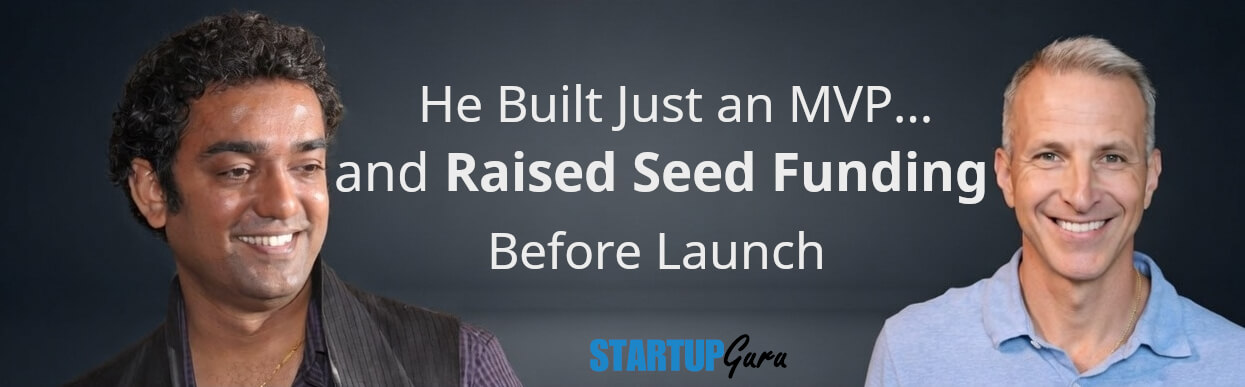

Most startup ideas never get past the idea stage. Others get stuck building products nobody asked for.
In this episode of the StartupGuru Podcast, I speak with David Mortellaro, a serial entrepreneur who has built multiple funded startups, including Sophosi (CoachesConnect), AleroSoft, and ClearBrook.
Instead of chasing ideas blindly, David has consistently focused on something many first-time founders overlook – validation before product.
In our conversation, we break down how founders should think about building their first version of a startup, how to test if people actually want the product, and what signals investors look for before writing the first cheque.
This discussion covers:
- How to approach MVP development without overbuilding
- Ways to validate a startup idea before committing months of work
- The mistakes founders make when launching their first product
- What traction really means in the early stages
- How early validation helps in raising seed funding
If you’re an aspiring founder or someone working on your first startup idea, this conversation will give you a clearer picture of what the zero-to-one journey actually looks like.
Watch the full conversation below.
In this post, we'll cover:
Podcast Transcript
Below is the full transcript of the StartupGuru Podcast conversation between Kunal Pandya, founder of StartupGuru, and David Mortellaro, serial entrepreneur and former founder of multiple funded startups.
David Mortellaro’s Background and Early Startup Journey
Kunal: Welcome to the StartupGuru podcast. We have today with us, David Mortellaro, who is an entrepreneur and currently working with Amazon. So David, it’s great to have you here. How are you doing?
David: Hi Kunal. Hi Kunal. Thanks for having me. Excited to be here today.
Kunal: Yeah, I’m really looking forward to unpacking your journey today. Not just what you have built previously while working with us, but also what you’re currently doing and what you’re trying to build. So we’ll keep it very simple. Let’s talk about your background and journey a little bit. What you were doing earlier and what kind of startup you were working on.
David: Yeah. I’ll give you a quick background. I started in tech way back in 1999 and worked at a big company, IBM. Around that time I was introduced to startups here in Austin, Texas. In the late 90s and early 2000s everyone thought they were going to be millionaires through startups. So I got the bug. I went from startup to startup over the next 10 years. Unfortunately we had the crash, 9/11 happened, the housing market in the US crashed, and many startups didn’t pan out. But I still had the bug.
David: So I went back to get a master’s degree at the University of Texas at Austin, McCombs School of Business, in Entrepreneurship to further my desire to own my own destiny as much as I could. From that I started my own software consulting company. I did that for a few years and realized it wasn’t as fulfilling. A few years later I ran into you all. I formed another startup with some former UT football players, which was super exciting to me. We formed a startup and found you guys. It was an amazing partnership that we worked together on and we were able to develop an MVP very quickly and get to market.
David: Unfortunately that startup fizzled out after a few years. I decided to use my skills entrepreneurially inside companies instead of being an entrepreneur directly. So I joined a larger company and now I’m at Amazon, still with a startup mindset. The project we’re working on is very startup related. It’s brand new greenfield development. Everything changes every day. I still use the same skills, but at the same time I always keep my eyes open for other opportunities and help anyone I can in the startup field. It’s not easy, but it is very rewarding.
Kunal: Right. Wonderful. So with Amazon, you mentioned you’re working in an entrepreneurial environment (intrapreneur). What exactly is your line of work there? Do you work with founders or what exactly do you do?
David: The project we’re working on is an internal tool that we’re developing. I work for Amazon Robotics specifically. Our customers are developers who build applications for all the IPCs, computers, and edge devices in fulfillment centers. What we’re writing is a brand new application to support them.
David: While we’re not supporting founders or working as an incubator, we operate like a startup. We meet with customers, gather requirements, change direction quickly, and move fast. We try to be scrappy and get things done quickly. That’s really the Amazon mindset. It’s always Day One. We’re the world’s largest startup, and that resonates with me greatly.
Early Challenges of Starting a Company
Kunal: Right. Talking about your entrepreneurial journey when you started, could you talk about the challenges you faced? When we hear about startups, we often imagine the exciting future ahead, but we sometimes forget the challenges and hiccups that naturally come along the way when building something. Did you face challenges, and how did you tackle them?
David: Sure. A lot of things were not as obvious to me as I thought they would be. When I got my degree from UT and started my own software consulting company, I had a contract with a state agency and thought I had made it. I had my own company. I was the CEO.
David: Then one day I woke up and felt like an imposter. I had just created a title for myself and didn’t feel like I deserved it. That mental struggle was something I didn’t expect. Running a startup comes with many everyday challenges, but the mental aspect was surprisingly hard.
David: Another challenge was that I was running the company by myself without partners. That became a slippery slope of accountability. It became easy to skip days. I had nearshore teams in Brazil and Guadalajara, but I didn’t stay as close to the business as I should have. Those were hard lessons.
David: Later, when I worked with partners and teams, things were much better. I’ve played sports my entire life and grew up in a big family, so I thrive in team environments. Working together as a team is where I do my best. That was an important lesson for me.
David: Entrepreneurs often think they should have everything figured out, but nobody does. Everyone is just trying to stay afloat and stay one day ahead. Looking back, those were some of the biggest lessons I’ve learned.
Kunal: That’s so true. At any point did you feel you needed external support? As a solo founder and a non‑tech founder, when did you decide you needed partners, development support, advisors, or strategy help?
David: I reached out to my network. Having a network is key to everything in your career and life. I was fortunate to be around a great group of entrepreneurs. I joined local entrepreneur groups where CEOs of small startups gathered. That was key for me.
David: I also hired coaches along the way. It was scary because when there’s not a lot of money coming in, investing in yourself feels risky. But it was very valuable. Eventually, I found partners in larger companies who had been in the business longer. They guided me on how to close contracts and grow the business.
David: Those people really helped me, but you have to go out and ask for help and look for it.
Kunal: We often hear non‑tech founders say they must first find a technical co‑founder. What is your take on that?
David: You definitely need someone with a technical background. In the startups I was part of, I was that technical advisor. When we found you all, I was able to work with you and vet different companies and understand what was needed without doing everything myself.
David: It’s great if you have a technical co‑founder fully committed, but at the very least you need someone who understands what is required and what the MVP should look like. There are many ways to solve a problem, and you want to avoid over‑engineering early on.
David: At the early stage, if your product is web‑based, you can simply launch a landing page and see if anyone cares. Even if the product isn’t ready yet, getting 10 signups is a signal. That validation is extremely important before building.
Why Startup Validation Matters Before Building a Product
Kunal: Validation is very important, but it’s not easy when you’re wearing the founder hat. Did this approach come naturally to you or did you learn it along the journey?
David: Part of the entrepreneurship program at UT focused on technology commercialization and market research. We also participated in pitch competitions where we presented ideas to real investors. That was my first exposure to validation.
David: It was scary. You don’t always know enough about the idea yet you’re trying to articulate and sell it. What I learned is that every investor is different. The same pitch won’t resonate with everyone, and that’s okay.
David: Entrepreneurship is a numbers game. You might meet a hundred investors to get one. The key is consistency and showing up every day.
Raising Funding and Talking to Investors
Kunal: Absolutely. Once you have validation, fundraising becomes a numbers game. You need the right mindset even when facing rejection.
David: Exactly. Investors often invest in the team more than the idea. Your idea will pivot many times before reaching the market. Investors are really partnering with you to refine the idea.
Kunal: Did you experience such pivot points in your startup journey?
David: Yes. Everything should be backed by data. Sometimes users asked for different things, sometimes features weren’t being used, and sometimes investors told us our market was too small.
David: That forced us to pivot toward a larger market. If you want to raise significant funding, investors want to see a big market opportunity.
Kunal: You worked with the team at NCrypted during your startup. How did you find them and why did you choose to work with them?
David: We found you through web searches. Our startup aimed to help athletic coaches find jobs and certifications. LinkedIn didn’t serve that audience well because many coaches weren’t active business users.
David: We wanted a LinkedIn‑like platform but didn’t want to build everything from scratch. You had lightweight clones that gave us a strong starting point.
David: What I appreciated most was that you acted as partners. Instead of simply building what we asked, you challenged us with better ideas. Within a few months we launched an MVP and gained thousands of users. That helped us reach our next funding milestone.
Within a few months we launched an MVP and gained thousands of users. That helped us reach our next funding milestone.
David Mortellaro
Kunal: That’s great to hear. After working with many startups we realized non‑tech founders face deeper challenges beyond technology. That led us to create StartupGuru, an incubation program supporting non‑tech founders building tech startups.
Kunal: The program focuses on four stages: idea, product, launch, and funding. The first stage focuses on problem‑solution fit and early validation before building anything.
Kunal: What is your take on such a program?
David: I wish something like this existed when I was starting out. A structured program with a network of innovators is extremely powerful. Being surrounded by people on similar journeys accelerates learning.
David: Even if your first idea fails, the experience and consistency will eventually lead you to success. Showing up every day and following the process makes the difference.
Kunal: Any final advice for founders starting their journey?
David: The most important thing is to start. Everyone has ideas, but nothing happens unless you take action. Do research, make the call, test the idea.
David: Most ideas will fail, but every attempt teaches you something. Failure only happens when you stop trying. Entrepreneurs must keep moving forward and keep showing up every day.
The Future of AI for Startups
Kunal: One last question. We’re living in the age of AI. What impact do you think AI will have on startups?
David: If you’re not exploring AI, you’re already behind. I spend hours every day using AI tools for research, market analysis, and even building MVPs.
David: AI won’t replace jobs, but it will replace people who don’t know how to use it effectively. Founders should learn how to work with these tools because the future is moving quickly in that direction.
Kunal: Fantastic. That brings us to the end of the podcast. Thanks a lot for sharing your insights, David. I really enjoyed this conversation.
David: Thank you. Please feel free to reach out to me on LinkedIn. I’d love to connect and continue the conversation.
Kunal: Definitely. We’ll include your LinkedIn details below the video so people can connect with you.
David: Sounds good. Thank you so much, Kunal. I appreciate it.
Kunal: Bye‑bye.
David: Bye‑bye.
About David Mortellaro
David Mortellaro is a serial entrepreneur and startup operator with experience building and scaling multiple ventures. He has previously founded or led startups including Sophosi, CoachesConnect, AleroSoft, and ClearBrook.
David began his career in technology in the late nineties, working at IBM before transitioning into the startup ecosystem in Austin, Texas. Over the years he has worked across product development, startup strategy, and early-stage venture building.
He currently works with Amazon Robotics, where he contributes to building internal platforms and tools that support large-scale robotics infrastructure and developer systems.
Connect with David Mortellaro on LinkedIn.
About the StartupGuru Podcast
The StartupGuru Podcast, hosted by Kunal Pandya, features conversations with startup founders who share how they went from idea to traction, built their MVP, validated their product, and raised early-stage funding.
Each episode focuses on the zero-to-one journey of startups, covering topics such as startup validation, MVP strategy, early traction, and fundraising.
Building Your First Startup?
If you’re a non-technical founder trying to go from idea to MVP and traction, explore the StartupGuru incubation program, where we help non-tech founders (building a tech/digital startup) validate ideas, build the first version of their product, prepare and get seed funding.