
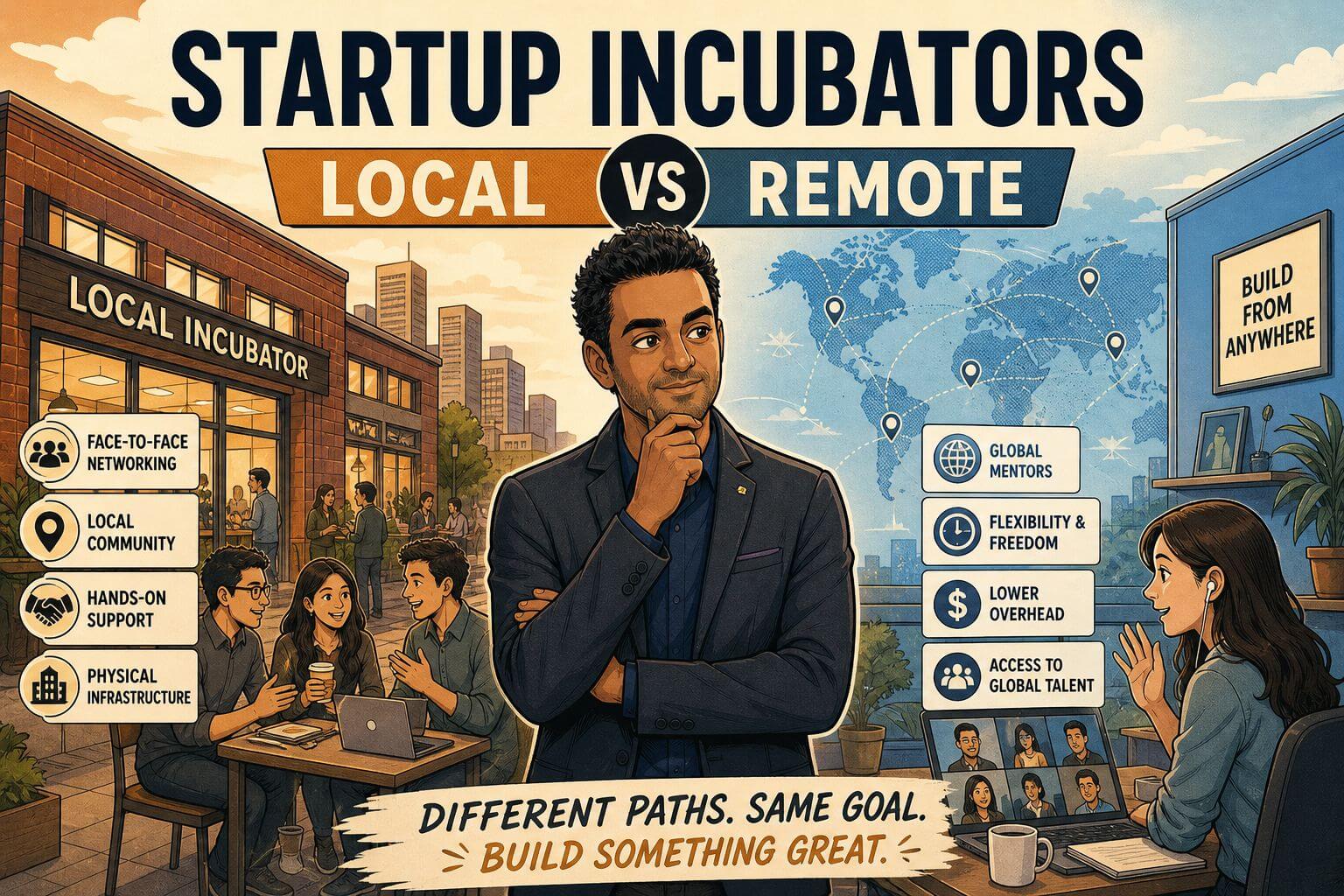

Every week, at least three non-tech founders slide into my DMs or show up on a StartupGuru discovery call and ask the same question: “Should I join an incubator?”
And then the very next sentence is always: “But should it be local or remote?”
Let me stop you right there. You’re asking the wrong question.
The question isn’t remote or local. The question is – what do you actually need right now?
Most founders get stuck on location because it’s a tangible decision. It’s something you can research, compare, and feel smart about deciding. You can Google “best startup incubators in San Francisco.” You can ask friends about the vibe at a particular co-working space. You can visit a demo day and convince yourself the energy is worth the relocation.
It’s all noise.
The distance between a startup that thrives and one that dies has never been measured in kilometres or miles. It’s measured in how fast you understand your customer, how honestly you validate your assumptions, and how well you execute – none of which depends on whether your laptop is plugged in at a co-working table or your kitchen counter.
I’ve mentored over 1,500 founders across my time at StartupGuru. Some joined our remote-first incubation program. Some went to local programs in their city. Some did both. Some did neither and built category-defining companies from their bedrooms.
Here’s the dirty secret of the startup world: a great incubator in the wrong format will waste your time and your equity. A mediocre incubator that fits your reality will still move the needle.
I’ve seen a brilliant founder join a prestigious local incubator, burn through six months of savings on rent and relocation, and come out with nothing but a polished pitch deck and zero revenue – because the program never forced her to talk to customers. I’ve also seen a founder join a remote program, keep his day job, validate his idea in eight weeks, and quit to build full-time with paying customers already lined up.
Same ambition. Same talent. Different format. Different outcome.
By the end of this article, you’ll have a clear framework to decide which model fits where you are right now – not where you think you should be, not where your friends went, but where your actual stage, constraints, and goals point.
Let me show you how to think about this. Because the wrong decision here doesn’t just cost you money. It costs you time – and for a non-tech founder, time is the one thing you never get back.
In this post, we'll cover:
- 1 The Rise of the Remote Incubator – Why It Matters Now
- 2 What a Local Incubator Actually Offers (The Good, The Bad)
- 3 What a Remote Incubator Actually Offers
- 4 The Factor That Actually Matters — Your Stage
- 5 The Founder Stories That Shaped My Thinking
- 6 5 Questions to Decide Remote vs Local Incubator
- 6.1 Question 1: Where Is Your Target Market?
- 6.2 Question 2: Can You Relocate for 3-12 Months?
- 6.3 Question 3: Are You Building Alongside a Day Job?
- 6.4 Question 4: Do You Need Structured Curriculum or Open-Ended Support?
- 6.5 Question 5: How Important Is In-Person Founder Community?
- 6.6 The Decision Framework
- 7 When a Hybrid Model Is the Sweet Spot
- 8 What to Look for in Any Incubator (Remote or Local)
- 9 The Truth – Most Founders Don’t Need a Local Incubator
- 10 The Founders Who Benefit Most From Remote Incubation
- 11 FAQ
- 11.1 Can I switch from a remote to a local incubator mid-program?
- 11.2 Are remote incubators less reputable than local ones?
- 11.3 How much equity do remote incubators typically take?
- 11.4 What if I’m in a different time zone?
- 11.5 Do investors take remote incubator startups seriously?
- 11.6 How do I network effectively in a remote incubator?
- 11.7 Is StartupGuru a remote incubator?
- 12 Conclusion
The Rise of the Remote Incubator – Why It Matters Now
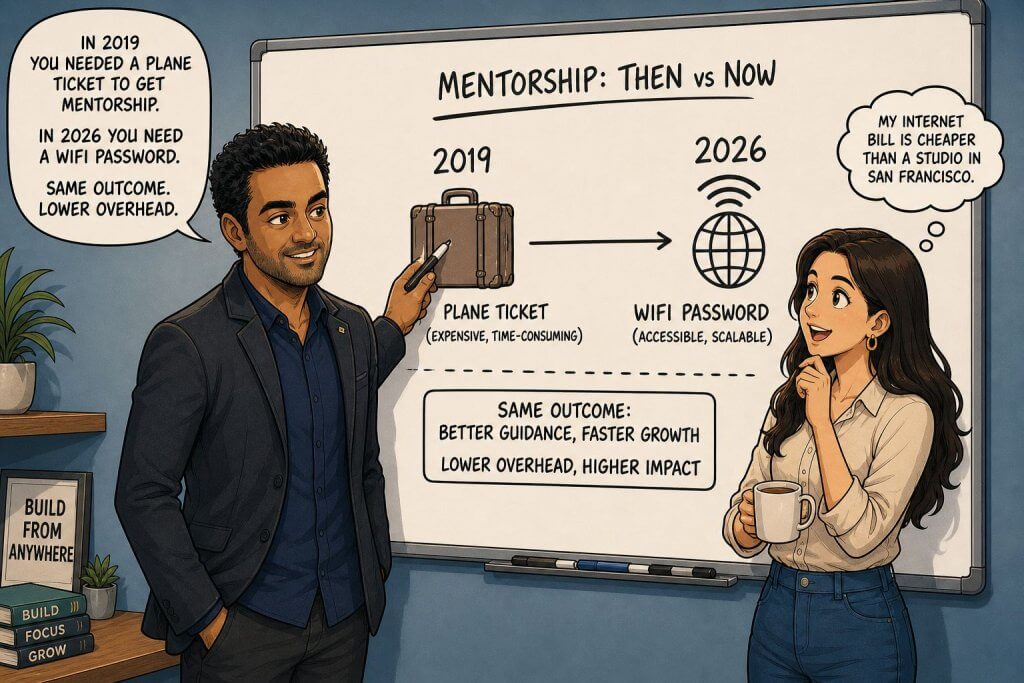
Let me take you back to 2019. Pre-pandemic. The startup world felt very different.
Back then, if you said you were joining an incubator, the immediate subtext was relocation. You packed a bag, got on a train or a plane, moved to a hub city — Bangalore, San Francisco, New York, London – and you sat in a physical room with other founders for three to six months. That was the model. That was the only model.
Remote-first incubators existed. A few pioneers were experimenting with virtual cohorts. On Deck was still in its early days. But the conventional wisdom was brutally simple: if you weren’t in the room, you weren’t getting the value. Investors thought the same way. I’ve sat in enough investor meetings where the first question was: “Are they local?” Not “Does their product work?” – but “Can I meet them for coffee this week?”
The logic was sound for its time. Before high-quality video conferencing, before async collaboration tools matured, before remote work was a proven model at scale, you had to be in the room. The mentorship, the networking, the accountability – it all depended on physical proximity.
Then 2020 happened.
The pandemic broke the geography barrier permanently.
And the data proves it. According to Gartner’s 2024 remote work survey, 68% of knowledge workers now operate in hybrid or fully remote environments — a number that has held steady since the initial post-pandemic spike, confirming that remote work wasn’t a temporary adjustment but a permanent shift. Statista reported that the global remote workforce grew by over 140% between 2020 and 2024. The startup ecosystem didn’t just adapt to this new reality – it accelerated.
Take Y Combinator. Historically the gold standard for the in-person incubator model. When the pandemic hit, YC fully transitioned to remote batches. And here’s what happened: TechCrunch reported that YC’s remote batches saw higher application volumes from outside the United States than any in-person batch in the company’s history. International founders who previously couldn’t relocate to Silicon Valley for three months suddenly had access to the world’s most prestigious startup program. The quality didn’t drop. The outcomes didn’t suffer. YC’s remote batches produced companies that went on to raise Series A, B, and beyond – just like their in-person predecessors.
YC didn’t go back to fully in-person after the pandemic. They didn’t need to. The data told them what I’m telling you now: talent, ambition, and great ideas exist everywhere. Not just in the five cities where incubators used to cluster.
The rise of remote incubators isn’t a trend. It’s a correction.
Think about what an incubator at its core is supposed to do: help you find product-market fit, provide mentorship, connect you to investors, and surround you with a peer group pushing in the same direction. Now tell me — what part of any of that requires a three-hour commute? What part requires expensive rent in a hub city you never planned to move to? What part justifies the stress of uprooting your family so you can sit in a room and type on a laptop?
Nothing. None of it.
The pandemic-era shift revealed something uncomfortable for the old guard: the local model wasn’t necessary. It was just habit. The barriers it created – relocation costs, fixed schedules, geographic exclusivity — weren’t features. They were bugs that everyone had learned to tolerate.
And for non-tech founders, these bugs were existential. A technical founder who can code might have the luxury of relocating because their skills are in demand anywhere. But a non-tech founder? Every rupee and every hour you spend on logistics is a rupee and an hour you’re not spending on customer discovery.
Most advice says: join the best incubator you can get into, regardless of location.
I say that’s half-right. The best incubator for you depends on what you need at your stage – and increasingly, the remote model gives you everything the local model promised, with fewer strings attached and lower risk.
If you’re still unclear on the fundamentals of what we’re even talking about, read our deep dive: What is a Startup Incubator?
Here’s the bottom line: by 2026, the remote-first incubator is no longer Plan B. It’s not a compromise. For many non-tech founders, it’s Plan A. And if you’re still operating with the pre-pandemic assumption that you need to move cities to get quality incubation, you’re making decisions on outdated information.
Let me show you why this shift matters specifically for you.
What a Local Incubator Actually Offers (The Good, The Bad)

I’m not here to trash local incubators. Let me be very clear about that.
Some of the best startup programs in the world are local. Some founders absolutely need that energy, that proximity, that friction of being in the same room. I’ve seen founders have transformative experiences in local programs – experiences that genuinely accelerated their trajectory by months or years.
I’ve also seen founders burn out, waste significant money, and quit entirely because the local model made promises it couldn’t keep. The cost of a bad fit isn’t just the program fee – it’s the opportunity cost of the six months you spent in the wrong environment.
Let’s look at both sides honestly.
The Undeniable Advantages of Local
1. Physical community and serendipitous interactions
There’s something real about walking into a room and seeing other founders grinding at 8 AM. You hear a fragment of a conversation about a problem you solved last week. You grab chai with someone who introduces you to a potential co-founder. You’re in a workshop and the person next to you asks a question that cracks open your entire business model.
Serendipity has a density function. The more talented, ambitious people you pack into a physical space, the higher the probability of useful random collisions. This is real. It matters. And it’s one of the hardest things to replicate in a virtual environment.
I’ve seen it play out firsthand. At StartupGuru, when we do our quarterly in-person meetups, the energy is palpably different. Conversations happen in hallways that don’t happen on Zoom. People find co-founders. They discover complementary skills. They make connections that turn into partnerships. Bonds form faster. Trust builds quicker. There’s a magic to it that I won’t pretend doesn’t exist.
2. Investor access tied to geography
This is the big one. Let’s not pretend otherwise.
If you join an incubator in San Francisco, you will meet San Francisco-based angel investors and VCs. The same in New York or London. Investors have a well-documented home bias – they invest where they can do due diligence over lunch, attend board meetings without flights, and leverage their local network for intros.
Harvard Business School published research showing that venture capital investment is significantly concentrated in geographic clusters. The top startup ecosystems – Silicon Valley, New York, London, Beijing, Bangalore — account for a disproportionate share of global venture funding. Investors in these ecosystems fund locally at much higher rates than they fund remotely.
Local incubators exploit this reality. They bring in local investors for demo days. They facilitate warm intros to the investor ecosystem. If you’re building something that serves a local market or needs local regulatory approval, local investor access is invaluable. You’re not going to raise from a Silicon Valley VC for a hyperlocal delivery service – you need local investors who understand that market.
3. Hands-on mentorship – whiteboard sessions, in-person workshops
There’s a tactile quality to in-person mentorship that’s genuinely hard to replicate virtually. A mentor walks to the whiteboard, draws out your customer journey map, circles the broken part in red, and says “This is where you’re losing them. Fix this first.”
You can’t feel that over a screen the same way. The energy of the room. The visual of the board. The way ideas arc through conversation when people are in the same physical space.
I’ve been on both sides of this equation hundreds of times. When I mentor founders in person, I read body language in ways I simply can’t on a video call. I know when a founder is bullshitting me – or bullshitting themselves. I know when they’ve genuinely understood a concept versus when they’re just nodding to be polite. The bandwidth of an in-person conversation is easily ten times what you get on a Zoom call.
4. Shared workspace energy and peer accountability
This is underrated in most incubator comparison articles.
When everyone around you is building, it’s contagious. You show up at 8 AM because everyone else is there. You stay late because the lights are on and someone’s ordering dinner. The collective momentum carries you through the low days — the days when your customer call didn’t go well, when you got rejected by an investor, when you’re questioning your entire idea.
Peer accountability in a physical setting is visceral. You can’t hide. You can’t turn your camera off and check out. The founder at the next table is going to ask you what you shipped today, and you have to answer.
I’ve written before about how startup incubators and accelerators differ, and this is one of those dimensions where understanding the difference matters. An accelerator’s time-bound, cohort-based nature amplifies the local energy effect even more — the shared deadline creates a collective pressure that’s powerful.
Now let me tell you what nobody brings up on the discovery call. The part that doesn’t make it into the glossy brochures.
1. Relocation or commute – the silent killer of founder momentum
You think moving to a new city for three to six months sounds exciting. It is – for the first two weeks. Then reality sets in.
You’re away from your support system. You’re paying rent in two cities or paying a premium for short-term housing. You’re dealing with the logistics of packing, moving, setting up internet, finding a place that doesn’t have construction noise from 7 AM. You’re eating out every meal because you don’t have a functional kitchen. Your laundry schedule is a mess. Your sleep cycle is disrupted.
For a non-tech founder who’s still figuring out whether their idea has legs, this overhead is a momentum killer. Every unit of energy you spend on logistics is one you didn’t spend on customer discovery. Every hour you spend hunting for a decent apartment in a new city is an hour you didn’t spend understanding your market.
I’ve had founders tell me they spent their first three weeks in a local incubator’s city just getting settled. Three weeks. That’s 25% of a typical incubator program wasted on logistics before the real work even started.
2. You’re limited to your city’s ecosystem quality
Here’s the uncomfortable truth that most local incubator marketing doesn’t advertise: not all startup ecosystems are equal.
If you happen to live in a thriving startup ecosystem – great. Your local options are solid.
If you don’t – if you’re in a smaller city or an under-served region – your local incubator options are going to reflect the limitations of that ecosystem. The mentor pool is thinner. The investor network is smaller. The peer group might be less ambitious because the bar for “success” in a smaller ecosystem is lower.
I’ve mentored founders from smaller cities who joined local incubators and got watered-down mentorship because the available mentors were well-intentioned but lacked the operating experience of building scalable companies. The incubator was honest and hardworking. The program was average. The network was weak. And the founder paid the price in months of wasted time and diluted equity.
Compare that to a founder in the same city who joined a remote program and got mentored by someone who’d scaled a SaaS company to 10,000 customers. The difference in outcomes isn’t subtle.
3. Time-bound schedules that don’t respect your reality
Local incubators run on a fixed schedule. Workshops at 10 AM. Mentor sessions at 2 PM. Demo day prep at 6 PM. You’re expected to be in the room.
If you have a day job – and most non-tech founders do when they’re starting out – this schedule is incompatible with your life. You’re forced to choose between building your startup and paying your bills. For many founders, especially in India where family financial responsibilities are significant, that’s not a real choice.
I’ve talked to founders who negotiated reduced hours at their job, took unpaid leave, or pretended to be available while juggling work calls from the incubator bathroom. That’s not building a startup. That’s performing entrepreneurship while burning out.
4. Same equity and fees, plus relocation costs
Here’s a piece of math that doesn’t get enough attention.
You pay the same equity or program fee as every other founder in the incubator. 5% equity. $5,000 in program fees. Whatever the terms are.
On top of that, you’re paying for relocation. Temporary housing deposit. Rent in the hub city. Commute costs. Eating out every meal. Higher cost of living in an urban center.
I’ve seen founders burn through $5,000-8,000 in additional costs over a three-month local program – on top of the equity they gave up. That’s money that could have funded customer acquisition, product development, or simply extended their runway by months.
Does that math make sense for a pre-revenue founder? Ask yourself: is the value of being in a physical room worth an extra $8,000 and 5% of your company?
Sometimes yes. Often no.
What a Remote Incubator Actually Offers

Now let me flip the table and talk about the model I’ve built my career around.
I run a remote-first incubation program at StartupGuru, so I’ll own my bias upfront. But here’s the thing – I didn’t build it remote-first because it was easier. I built it remote-first because I watched too many talented non-tech founders pass on incubation entirely. They couldn’t afford to relocate. They couldn’t quit their jobs. They had family responsibilities.
And the startup ecosystem was telling them, implicitly, “If you can’t move to a hub city, you don’t deserve mentorship.”
That’s not just exclusionary. It’s stupid.
Because the founders being filtered out by the local-only model aren’t the least committed. They’re often the most resourceful – the ones who have responsibilities they can’t abandon, who’ve figured out how to build businesses while managing real-world obligations. Those are exactly the founders you want in your portfolio.
Why Non-Tech Founders Thrive in Remote Incubators
1. Access to global mentors – not just whoever’s in your city
This is the single biggest advantage of the remote model, and it’s not close.
When you join a local incubator, your mentor pool is geographically constrained. You get whoever lives in or is willing to commute to your city. Maybe that’s an amazing set of people. Maybe it’s average. You don’t have a choice.
When you join a well-run remote program, your mentor could be in San Francisco, Berlin, Singapore, Bangalore, Dubai, or London – all in the same day. You’re not limited by geography. You’re limited only by the program’s network and curation quality.
Let me give you a real example from StartupGuru. We had a founder from a small city in Ohio building a B2B SaaS product for small manufacturing businesses. There was exactly zero manufacturing SaaS expertise in his local startup ecosystem. The local incubator he looked at had mentors who’d built e-commerce and consumer apps. Useful, but not relevant.
Through StartupGuru, he was paired with a mentor who had built and exited two manufacturing-tech SaaS companies in California. The mentor understood the specific dynamics of selling to factory owners: the long sales cycles, the trust-building required, the integration challenges. He got six months of mentorship from someone who’d walked exactly the path he was walking.
He would never have met that mentor in any local program. The mentor wasn’t flying to Ohio for weekly sessions. But he hopped on Zoom for an hour every week, and the quality of guidance was transformative.
Your access shouldn’t be limited by your postal code. That’s an artificial constraint, not a real one.
For non-tech founders, this is especially critical. You don’t need a co-founder who can code this week. You need someone who’s been through the journey of finding product-market fit without co-founding with a techie. You need frameworks for validating your idea without writing a line of code. You need to know what questions to ask if you’re hiring a developer, how to evaluate technical risk, and how to communicate your vision to technical people.
And the best person to teach you those things might not live in your city. In fact, they almost certainly don’t.
We cover this extensively in our guide on MVP Development for Non-Technical Founders. The right guidance matters far more than the right geography.
2. Flexible schedule – build alongside your day job
This is the sleeping giant of remote incubation. The feature that matters most to real founders living real lives.
Most non-tech founders cannot quit their jobs on day one. They have EMIs, rent, family commitments, savings that are modest at best. A local program that requires you in a physical room at 9 AM every day effectively forces you to choose between income and incubation.
A remote program eliminates that false choice. You attend live sessions when you can. You watch recordings when you can’t. You schedule 1:1 mentor calls in the evenings or weekends. You do your customer discovery work during lunch breaks and after work hours.
The result: you can keep your day job, validate your idea on nights and weekends, and only take the plunge when you have real signals – paying customers, validated demand, a clear path forward.
I always say to our founders at StartupGuru: protect your downside while you test your upside.
Remote incubation makes that possible. Local incubation, by its nature, makes it far more difficult.
3. Lower barriers for underrepresented founders
This deserves an entire article on its own, so let me give you the quick version.
Women founders. International founders. Caregivers. Founders with disabilities. Founders from non-metro cities. Founders from communities that are underrepresented in mainstream startup ecosystems.
The local model has historically been terrible for all of these groups. Not intentionally – but structurally. If you can only access incubation by relocating to a hub city, you’re filtering for founders who have the financial resources, family flexibility, and social privilege to move. Everyone else gets left behind.
A woman founder in a city where the startup ecosystem is heavily male-dominated faces additional barriers in a local program: being the only woman in the room, dealing with unconscious bias in mentor interactions, navigating networking events that skew heavily male. A remote program removes many of these dynamics – she engages with mentors and peers on her own terms, in a format where her voice gets equal space in the chat and the call.
A founder who’s the primary caregiver for an aging parent or a child with special needs can’t relocate for three months. It’s not a preference – it’s a logistical impossibility. The local model says “sorry, you’re out.” The remote model says “let’s make this work.”
This isn’t charity. It’s pattern recognition. Some of the best founders I’ve worked with at StartupGuru came from backgrounds that traditional local programs would have filtered out. They built better companies because they had to be more resourceful, more disciplined, and more creative.
4. Structured virtual curriculum with documented progress
Here’s a counterintuitive truth: well-run virtual programs are often more structured than local programs, not less.
Why? Because when you can’t rely on hallway conversations and incidental learning to transfer information, you build better systems. You create recorded sessions. You write documented playbooks. You define trackable milestones. You build progress metrics that a founder and mentor can look at and say “we’re on track” or “we’re not.”
In a local program, a huge amount of the learning is ephemeral. It happens in conversations that don’t get documented. It depends on who you happened to sit next to at lunch. The quality of your experience is highly variable based on factors outside your control.
In a well-run remote program, everything is captured. You can rewatch a session on customer discovery techniques from week one when you’re in week eight. You can reference the exact framework a mentor taught you. Your progress is measured against clear milestones – not vibes.
This matters especially for non-tech founders. You don’t have the same feedback loops that a technical founder gets from their code compiling or their build passing. You need external structure and clear milestones to know you’re making progress. A good remote program gives you that.
The Tradeoffs Nobody Talks About
I promised I’d be honest about the downsides. So here they are, laid out plainly.
1. Self-discipline is table stakes, not optional
In a remote incubator, nobody is watching you work. You can turn your camera off and mentally check out of a session. You can skip a week of work and nobody will notice until you miss a deadline.
This freedom is liberating for self-starters. It’s destructive for founders who depend on external accountability.
If you’re the kind of person who thrives with a room full of people working next to you – who needs the social pressure to stay focused – a remote program will expose that dependency fast. The program can provide structure, and good programs do, but it can’t force you to engage. That’s on you.
I’ve seen remote founders crush it because they’re naturally disciplined and focused. I’ve also seen remote founders drift for weeks, showing up to sessions but not doing the work between them, and wondering why they’re not making progress.
2. Less organic networking – you have to be intentional
This is the tradeoff I hear most often from founders who’ve experienced both models.
In a local program, networking happens by default. You’re in the same space. You eat lunch together. You grab chai between sessions. You complain about the same mentor. The connections form organically.
In a remote program, you have to be deliberate. You need to schedule virtual coffee chats. You need to actively participate in Slack channels. You need to attend optional networking sessions. You need to reach out to peers instead of waiting for the chance encounter.
Some founders are natural networkers and excel at this. Others find it exhausting and retreat into their own work, missing the peer connections that are a core benefit of incubation.
If you’re the latter, a remote program requires you to develop a skill you might not have. The upside: it’s a valuable skill for entrepreneurship in general. The downside: it adds cognitive load to an already demanding process.
3. No physical separation between work and home
This is real. It’s underdiscussed. And it matters.
When your incubator is in your house or your home office, the boundary between “building my startup” and “living my life” dissolves. There’s no commute that signals the end of the workday. No physical transition between “incubator mode” and “home mode.”
I’ve seen remote founders burn out because they never stop working. They open their laptop at 7 AM and close it at midnight, and in between they’ve done eight hours of “real work” and four hours of aimless browsing that felt like work but wasn’t.
You need to engineer boundaries yourself. Scheduled shutdown times. A dedicated workspace – even if it’s a specific corner of a room. Rituals that mark the start and end of your work session. If you can’t do this, remote incubation will drain you faster than any local program would.
4. The “out of sight, out of mind” risk with mentors
This is uncomfortable to talk about, but it’s one of the most common complaints I hear from founders in remote programs.
In a local incubator, you see your mentors every week. You’re a person, not a name in a calendar. They remember your face, your story, your specific challenges. The relationship has texture.
In a remote program, you’re one of many founders in their inbox. The relationship requires more active maintenance. You need to send regular updates. Follow up after calls. Share progress. Ask specific questions. If you’re passive, mentors will naturally focus their attention on the founders who are most present and proactive.
The best remote programs compensate for this with structured check-in systems – mandatory weekly updates, scheduled review sessions, shared progress dashboards. But even with the best systems, the onus is on you to build and nurture those relationships.
The Factor That Actually Matters — Your Stage
Let me give you the framework I use when founders ask me this question in person.
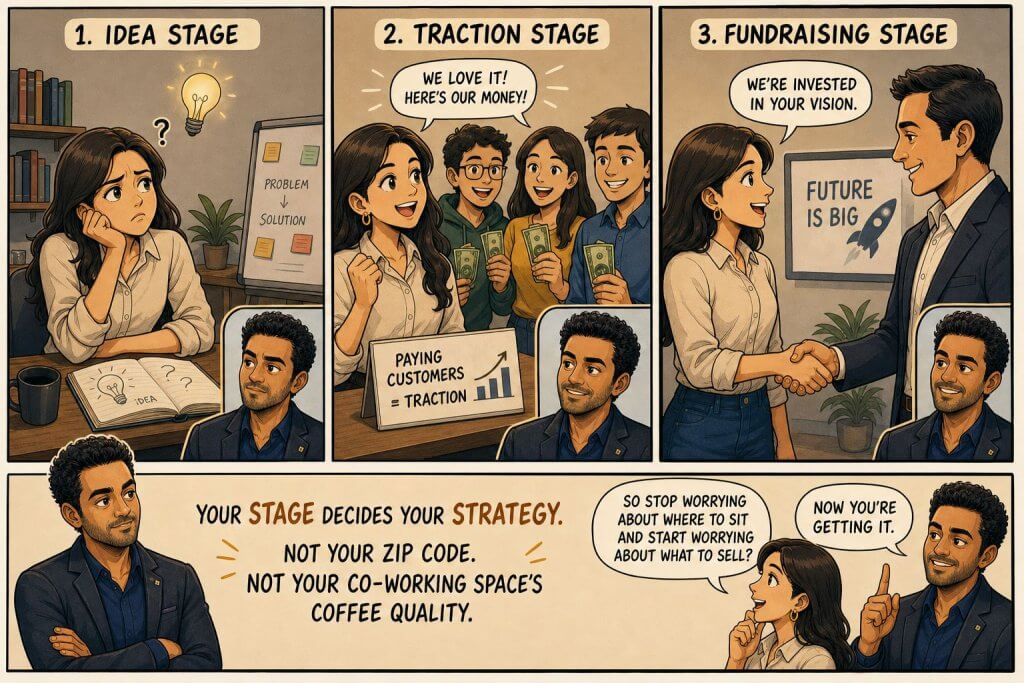
It comes down to one variable: where are you in the journey?
Not your location. Not your budget. Not your family background. Not how impressive your pitch deck looks.
Your stage.
Here’s how I break it down.
Are You Pre-Validation (Idea Stage)?
If you have an idea but you haven’t confirmed that anyone will pay for it – and I mean actually pay, not “sounds interesting” – you’re in the danger zone.
And the danger zone is exactly where most founders are when they apply to incubators. They have an idea. They’re excited. They want validation. But they’re not sure how to get it.
Remote can be better here, and honestly, it’s not close.
Why? Because at the idea stage, what you need most is frameworks. You need a systematic process for testing your assumptions. You need someone to push you out of the building, metaphorical or literal, and into conversations with potential customers.
The mentor who helps you at this stage isn’t the one who writes a cheque. It’s the one who asks the hard questions: Who specifically has this problem? How do you know? How many of them have you talked to? What have they tried before? What would they actually pay for a solution?
I’ve seen this pattern play out too many times: a founder joins a prestigious local incubator at the idea stage, spends the first two months “networking” with other founders in the co-working space, feels productive because she’s surrounded by busy people, attends workshops on growth hacking and fundraising that she’s not remotely ready for, and emerges three months later with zero customer conversations and the same unvalidated idea she started with.
The co-working space gave her the feeling of progress without the substance.
In a remote program designed for the idea stage, she’d have been pushed into customer discovery by week one. She’d have a framework for structuring interviews. She’d have scheduled mentor check-ins specifically focused on validation progress. She’d have a clear milestone: talk to 20 potential customers and report back on patterns.
If you need a structured approach to this phase, start here: How to Validate Your Startup Idea
The core of validation is simple: 1:1 conversations with potential customers. You don’t need to be in a co-working space for that. You need a phone or a video call tool, a good question script, and the courage to hear “no” twenty times a day.
At the idea stage, distance is irrelevant. What matters is the quality and speed of your discovery process.
Do You Have Some Traction?
If you have paying customers – even three, even five, even one who pays a meaningful amount – the calculus changes.
You’ve done the hardest part. You’ve proven that someone, somewhere, will exchange money for what you’re building. That’s real traction. It tells you more than any amount of validation interviews ever could.
With traction, either model can work. You need to scale what’s working, and both remote and local programs can help you do that.
But here’s where the “MSP-first” approach becomes critical. At StartupGuru, we’re fundamentally obsessed with this distinction: MSP vs MVP – Minimum Sellable Product vs Minimum Viable Product.
Most founders have heard of the MVP – Minimum Viable Product. Build the smallest thing that works, get it in front of customers, iterate. It’s the Lean Startup gospel.
Here’s the problem: the MVP mindset often leads to building features nobody pays for. You build a “viable” product that nobody considers valuable enough to open their wallet for. You get users but not revenue. You have traction metrics but no business.
The MSP – Minimum Sellable Product – flips this. Instead of asking “what’s the smallest thing I can build?”, you ask “what’s the smallest thing someone will pay for today?” You optimize for revenue, not usage. You validate willingness to pay, not just willingness to try.
A remote incubator supports the MSP approach better than most local programs do, because you’re building to sell, not building to demo. You’re not preparing a presentation for a local cohort where everyone applauds your prototype. You’re shipping something functional to a real customer, collecting payment, and iterating based on what the market tells you.
I always say to our founders at StartupGuru: your job is not to define how the product is built. Your job is to define what needs to be proven.
At the traction stage, the remote vs local question is secondary to a more important one: does this program give me the specific traction-building frameworks I need? If a local program has a proven methodology for scaling revenue, it’s worth considering. If it just offers generic workshops and office space, the remote option with a focused traction curriculum is almost certainly better.
Are You Ready to Raise?
If you’re at the fundraising stage – pre-seed or seed round – the conversation gets more nuanced, and I’ll give you the honest answer.
Local incubators have a structural advantage here. In-person investor intros close faster than virtual ones.
Investors are human beings with biases. They trust founders they’ve shaken hands with. They write larger cheques to people they’ve shared a meal with. The pattern is well-documented in academic research and backed up by every VC I’ve ever met. Pretending otherwise is naive.
When you meet an investor in person, you get the full bandwidth of communication. Body language. Eye contact. The energy of the room. These signals matter when someone is deciding whether to bet half a crore or more on you and your idea.
But here’s the critical update for 2026: the gap has narrowed dramatically.
Top remote programs now have global investor networks that rival, and sometimes exceed, local ones. At StartupGuru, we’ve connected founders from smaller US cities and emerging markets with investors in Silicon Valley, New York, London, Singapore, and Dubai. The deals close. The cheques clear. The skepticism about remote investing that existed in 2020 is largely gone.
Stripe’s guide to accelerators notes that remote-first investor networks have matured to the point where geographical dispersion is no longer a dealbreaker for most institutional investors. The tools for virtual due diligence – data rooms, async updates, recorded pitches – are now standard practice.
The old narrative – “you need to be in San Francisco or Bangalore to raise money” – is dying. It’s not dead yet, I’ll be honest about that. Some investors still prefer local. Some funds still have geographic mandates. But the trend is unmistakable: the best founders of 2026 are raising from anywhere and everywhere.
For a detailed breakdown of what the fundraising landscape looks like at each stage: Startup Funding Stages – From Pre-Seed to IPO
My honest take: if you’re at the fundraising stage and your target investors are concentrated in one city – say you’re building a healthcare startup and all the healthcare VCs are in San Francisco – a local program with strong ties to that ecosystem might be worth the relocation. The cost of relocation is a fraction of what you’re raising.
If your investors are distributed globally – which is increasingly true even for Indian startups, as more international funds look at the Indian market – remote gives you better coverage with zero relocation overhead.
The Founder Stories That Shaped My Thinking
I’ve been doing this long enough to have a library of patterns. Let me share three real founder stories that illustrate why stage matters more than location.
The Founder Who Chose Local and Won
Marcus was building an edtech platform for professional certification prep. He was based in Columbus, Ohio. When he got into a local incubator in his city, one of the few in his region, he decided to stay local because he couldn’t afford to relocate to a bigger tech hub.
The program was average by national standards. The mentors were well-meaning but hadn’t built scalable companies. The investor network was thin.
But Marcus used the one thing the program gave him well: structure. He showed up every day. He built relationships with the other founders. He used the time to focus on customer discovery in the local market he understood deeply.
By month four, he had paying customers in three districts. By month eight, he had enough traction that investors from the nearest hub city reached out to him. He never relocated. He never needed the program’s investor network. He used the structure to build, and the traction spoke for itself.
The Founder Who Chose Local and Lost
Jessica had a solid B2B idea – a tool for small retailers to manage inventory across multiple suppliers. She was in a smaller US city. She got into a well-known local incubator in a bigger tech hub.
She relocated – just two cities over, but it was still a move. She spent $2,000 a month on temporary housing. She took unpaid leave from her job. She spent her first month settling in.
The incubator’s program was heavily focused on pitch deck refinement and demo day preparation. But Jessica was at the pre-validation stage. She needed customer discovery frameworks. She needed to talk to 50 small retailers before writing a line of code.
Instead, she spent twelve weeks perfecting a pitch deck for an idea she hadn’t validated. At demo day, she had a beautiful deck, glowing feedback from mentors, and exactly zero customer commitments.
She ran out of savings and went back to her job. The idea died. Not because it was bad – but because she was in the wrong format for her stage.
The Founder Who Chose Remote and Thrived
Sarah was a non-tech founder in a smaller US city. She had an idea for a platform connecting freelance designers with small businesses – a marketplace play. She had no technical background, no co-founder, and limited savings.
She discovered StartupGuru through a blog post about MVP Development for Non-Technical Founders and applied to our remote incubation program.
Here’s what happened:
Sarah kept her day job through all twelve weeks. She worked evenings and weekends. She never relocated. She spent exactly zero on commuting or temporary housing.
Eighteen months later, her startup has 200+ verified designers and processes $80,000 in monthly transaction volume. She just raised her first institutional round from an investor who found her through an online pitch event.
Sarah’s success wasn’t because of the remote format. It was enabled by it. She needed frameworks, not geography. She needed 1:1 validation support, not a demo day crowd clapping at her slides. She needed the flexibility to keep her income while she tested her idea.
Three founders. Three different outcomes. The variable wasn’t the format – it was whether the format matched their stage.
5 Questions to Decide Remote vs Local Incubator
Alright, let’s get practical. I’m going to give you a decision framework you can use right now, this week, without overthinking it.
Answer these five questions honestly. No sugarcoating. No “well, technically…” – just honest answers based on where you are today, not where you hope to be in six months.
Question 1: Where Is Your Target Market?
This is foundational. If your customers are local, same city, same state, same specific region, a local incubator with ties to that geography gives you an advantage. You can test your product with real local customers. You can build relationships with local partners. You can understand local regulatory dynamics better through your peer group.
If your customers are global, anyone with an internet connection, remote is almost certainly better. You need global perspectives on your market. You need mentors who understand international customer behavior. You need to think globally from day one, and a remote incubator’s global mentor pool supports that.
Decision: Local for local market. Remote for global market.
Question 2: Can You Relocate for 3-12 Months?
This isn’t a question of desire. It’s a question of capability.
If you can relocate without major disruption – no job you can’t leave, no family obligations that require your physical presence, no financial strain from maintaining two residences – then local programs are on the table. You have the flexibility to consider them.
If you cannot relocate without significant sacrifices – leaving a stable job, disrupting your children’s education, taking on debt to cover double rent – then the answer is remote. Full stop. Don’t romanticize the local experience. Don’t convince yourself you’ll “figure it out.” The stress of forced relocation will eat into your founder focus.
Decision: Can relocate easily → both options open. Cannot relocate → remote is your answer.
Question 3: Are You Building Alongside a Day Job?
Be honest about this. Most incubators ask you to commit full-time. But the reality for most non-tech founders is that they need income while they build.
If you’re keeping your day job, you need flexibility. Remote programs offer recorded sessions, asynchronous participation, and evening/weekend scheduling. Local programs generally don’t — they expect you in the room during business hours.
I’ve talked to founders who tried to do both: keep a day job while attending a local incubator. The result was usually burnout within six weeks. They’d sneak off to take mentor calls from the office bathroom. They’d miss workshops because of work meetings. The mental load of juggling two commitments in a format designed for one is unsustainable.
Decision: Have a day job → remote. No day job → either model works.
Question 4: Do You Need Structured Curriculum or Open-Ended Support?
This is about your learning style and your stage, not your preference.
If you’re early-stage and uncertain, you likely need structured curriculum. A clear path: “Week 1 do customer discovery, Week 2 analyze patterns, Week 3 define your MSP, Week 4 make your first sale.” Remote programs excel at this because their content is documented, recorded, and reproducible.
If you’re later-stage and know what you need – “I need help with pricing strategy” or “I need introductions to healthcare investors” – open-ended support might serve you better. Local programs can provide this through spontaneous mentor availability and the ability to grab coffee with an expert who happens to be in the building.
Decision: Need structure → remote programs are better documented. Need open-ended support → local has advantages for spontaneity.
Question 5: How Important Is In-Person Founder Community?
This is the emotional variable. Be honest, not aspirational.
If you get energy from being around people, if you struggle to work alone, if the energy of a room full of builders is what keeps you going — don’t fight your nature. Consider local or hybrid. The best incubator in the world won’t help you if you’re not engaged, and if physical community is your fuel, a purely remote program might leave you running on empty.
If you’re naturally self-motivated, if you have a strong support system outside of founders, if you focus better without the distractions of a shared workspace – remote works perfectly. You’ll get the substance without the overhead.
Decision: In-person community is critical → local or hybrid. Self-motivated → remote works well.
The Decision Framework
Score yourself. Give 1 point for every “Remote” answer and 0 for every “Local” answer.
| Question | Remote (1 pt) | Local (0 pt) |
| Target market | Global | Local |
| Can relocate | No | Yes |
| Day job | Yes | No |
| Structure needs | Prefer curriculum | Prefer open-ended |
| Community need | Low | High |
Score 4-5: You’re a strong remote candidate. Don’t let anyone convince you to uproot your life.
Score 2-3: You’re in the hybrid zone. A remote-first program with periodic in-person touchpoints could be your sweet spot.
Score 0-1: Local might serve you better – but only if there’s a quality program in your city that matches your sector and stage.
One more thing: This framework isn’t static. Revisit it as your stage changes. A founder who scores “remote” at pre-validation might score “local” at fundraising. That’s fine. The right answer changes with your circumstances.
When a Hybrid Model Is the Sweet Spot
Here’s what I’ve learned after working with hundreds of founders over the past decade: the best model isn’t pure remote or pure local. It’s remote-first with intentional in-person touchpoints.
Think about it. You get the flexibility, global access, and low overhead of remote. Plus you get the energy, trust-building, and serendipitous connections of in-person – but only when it matters most.
This isn’t theoretical. Some of the best startup programs in the world are moving toward this hybrid approach:
At StartupGuru, this is exactly how we operate. We’re remote-first – you don’t need to relocate, you don’t need to quit your job, you don’t need to be in any specific city. Our core program is designed for flexible, structured participation from anywhere.
But we also bring founders together periodically. Quarterly workshops. Mentor intensive weekends. Cohort meetups. These touchpoints give you the in-person experience – the whiteboard sessions, the after-hours conversations, the trust-building – without the permanent relocation overhead.
The hybrid model works because it respects your constraints while still giving you what you actually need: guidance, community, and accountability.
If you’re in that 2-3 score zone, or if you’re torn between two good options, look for a program that offers this balance. Read our guide on What to Consider Before Starting Your Startup for a broader framework on evaluating your options.
What to Look for in Any Incubator (Remote or Local)
Once you’ve decided on the format, you need to evaluate the program itself. And let me tell you: most founders evaluate the wrong things.
They look at the brand name. They check the website design. They count Instagram followers. They Google “startup incubator reviews” and read three testimonials.
None of that tells you what matters.
Here’s what to actually evaluate.
Mentor Quality, Not Quantity
I don’t care if an incubator has 200 “mentors” listed on their website. I care about who those mentors are and how they actually engage with founders.
The right question: Do the mentors have real operating experience building companies in the space I’m targeting?
A mentor who built a B2B SaaS company from zero to $5M+ ARR is worth more than 50 mentors who’ve never met a payroll or dealt with churn. A mentor who’s exited a company in your sector is worth more than a hundred who’ve attended startup conferences.
Ask for specific mentor profiles. Ask which mentors will work directly with you. Ask what their engagement model is — is it one session per month? One per week? Ad-hoc? Do they have office hours? Can you reach them between sessions?
If the incubator can’t name the mentors who’ll work with you, that’s not a mentor network – it’s a list of names on a website.
Alumni Outcomes and Transparency
This is the single most reliable signal of program quality.
Good incubators publish their alumni outcomes – and not just the success stories. They show you which companies succeeded, which raised funding, which shut down, and what the common patterns were. They share data: percentage of alumni still active, average revenue at graduation, average time to first paying customer.
Mediocre incubators give you vague testimonials and cherry-picked case studies. They say “we’ve worked with 500+ startups!” without telling you that 450 of those are now dormant. They show you the one founder who raised $500K, not the forty who raised nothing.
If an incubator isn’t transparent about outcomes, assume the worst. The data that IS available will tell you more than any curated testimonial.
The Specific Help You Get – Methodology Matters
Don’t evaluate an incubator on its elevator pitch. Evaluate it on the specific playbooks and methodologies it uses.
Do they have a structured process for problem-solution validation? Do they teach founders how to build an MSP (not just an MVP)? Do they help you get traction before you even think about fundraising? Do they connect you to customers, not just to investors?
At StartupGuru, our entire incubation model is built around three pillars: Sell First > Then Build > Then Raise. It’s not a slogan we put on a t-shirt. It’s the order of operations for every founder we work with. Every mentor session, every workshop, every milestone is aligned with that sequence.
If an incubator can’t articulate a clear methodology for how it helps founders go from idea to revenue, that’s a red flag. You don’t want generic support – you want a system that’s been tested and refined across hundreds of founders.
Terms and Equity – What You’re Actually Giving Up
This deserves more depth than I can give it here, but let me give you the essentials.
Most incubators take between 3% and 10% equity. Some charge program fees of $1,500-$6,000 instead of equity. Some take nothing upfront and require a success fee on future funding. The range is wide, and the right amount depends entirely on what you’re getting.
According to CB Insights’ startup failure analysis, 35% of startups fail because there’s no market need. That’s the #1 reason for failure, ahead of running out of cash (29%) or having the wrong team (23%).
Here’s what that means: if an incubator helps you validate that your market exists – proving that people will pay for what you’re building — it has addressed the single biggest risk your startup faces. If it helps you avoid building something nobody wants, the equity or fees are probably worth it.
But here’s the catch: many incubators take equity without providing that specific validation support. They take your 5% and give you generic workshops on growth hacking, pitch deck design, and “networking strategies” – content that’s useless until you’ve validated that anyone wants your product.
Y Combinator’s standard deal – historically around $500K for 7% (terms change, check current) – works because the network, brand, and alumni community provide enormous value that compounds over time. Not every incubator can make that claim.
Before signing anything, ask yourself: What specific risks is this incubator helping me address? And are those the risks I actually face right now?
If you’re pre-validation and the incubator’s main offering is investor introductions, you’re paying for the wrong thing. You’re addressing a problem you don’t have yet.
The Truth – Most Founders Don’t Need a Local Incubator
I’m going to say something that might annoy some of my peers in the incubator ecosystem.
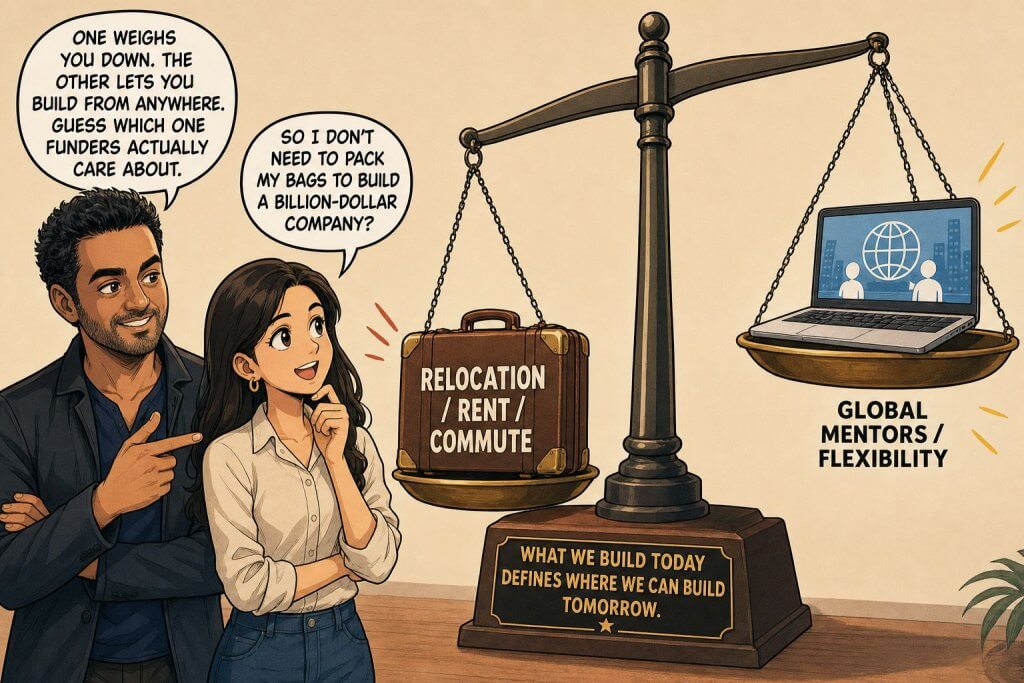
Most founders don’t need to relocate for an incubator. Most incubator benefits don’t require physical presence.
The local model was built for a world where:
That world is gone. And most incubators haven’t fully updated their value proposition to reflect the new reality.
The local model also makes an implicit assumption that many founders simply can’t afford: that you can pause your life. That you can walk away from your job, your family obligations, your existing commitments for three to six months. That your savings can absorb the shock of double rent and higher living costs.
That’s not a reasonable assumption for most non-tech founders. It’s not a sign of insufficient commitment. It’s a sign of a model that hasn’t adapted.
Remote incubation removes that barrier. And for non-tech founders especially, this is transformative.
Here’s why: your focus as a non-tech founder should be on understanding the problem deeply. Not on learning to code. Not on relocating to impress an investor panel. Not on spending money you don’t have on rent in an expensive city.
Your actual job is to:
None of these four tasks require a particular zip code. None of them require you to quit your job. None of them require you to pack your bags and move cities.
The founder who wins is the one who validates fastest, not the one who relocated farthest.
This isn’t just my opinion. It’s backed by the fundamental principles of The Lean Startup Methodology. Eric Ries’s core insight is that startups exist to learn how to build a sustainable business. The faster you learn, the faster you win. Physical location has almost nothing to do with your learning velocity.
I also recommend reading our analysis of Why MVPs Fail. The most common reason? Founders build before they validate. That’s a methodology problem, not a proximity problem. The city you live in won’t save you from building something nobody wants.
Here’s the question I want you to sit with: If I got everything I need from an incubator – mentorship, frameworks, peer support, structure — without moving cities, what would change?
For most founders, the answer is “nothing essential.” You’d still need to talk to customers. You’d still need to iterate. You’d still need to sell. And you’d do all of that from wherever you already are.
The Founders Who Benefit Most From Remote Incubation
When I look at our cohort at StartupGuru, I notice a clear pattern. The founders who get the most out of a remote-first incubation aren’t the ones who already live in startup hubs – they’re the ones the traditional ecosystem leaves out.
Let me be specific about who I’m talking about.
Black and underrepresented founders in the US. If you’re a Black founder building a tech startup in Atlanta, Detroit, or Houston, your local incubator options exist – but the quality is inconsistent. The mentor networks in those cities might not have deep Silicon Valley operating experience. The investors coming to local demo days might not write the size of checks you need. A remote-first program gives you access to mentors and investors who’ve built at scale, without requiring you to relocate to San Francisco or New York. That’s not just convenience. That’s leveling a playing field that’s been tilted against you from the start.
Women founders balancing career and family. I’ve worked with dozens of women founders who carry a disproportionate share of caregiving responsibilities – children, aging parents, the invisible load that entrepreneurship rarely accounts for. The local incubator expects you to show up at 9 AM, stay until 8 PM, and attend networking drinks after. That schedule is designed for someone without real-world obligations. Remote incubation respects your time. You attend sessions that work around your life. You get the same mentorship intensity on a schedule that doesn’t ask you to abandon your responsibilities. I’ve seen founders in this exact position validate their ideas, find product-market fit, and build successful companies – all while managing schedules that a local incubator would have rejected outright.
Immigrant and first-generation founders. If you’re an Asian-American founder in a US Tier 2 city – or a first-generation professional who moved to a new country and is now building a startup – you know the ecosystem isn’t built for you. The typical local incubator advice assumes you have family wealth to lean on, a safety net to fall back on, and connections to tap into. Remote incubation removes those assumptions. You get the frameworks, the mentorship, and the accountability without having to look like you “belong” in a room full of people from different backgrounds.
Career-switchers transitioning from corporate roles. This is one of our fastest-growing founder segments at StartupGuru. Professionals who’ve spent 8-15 years in corporate jobs – consulting, finance, operations, sales – and want to build their own thing. They have domain expertise. They have savings. They have networks. But they don’t have a co-founder, a technical background, or a clear path from idea to product. Remote incubation works for them because they don’t need to quit their job on Day 1, relocate to a startup hub, or pretend they’re 22 years old sleeping on a friend’s couch in a co-living space. They need structured guidance to transition from professional to founder. And the best place to get that guidance isn’t a co-working space in a city they don’t want to live in.
The through-line here is simple: the traditional incubator model filters out the exact founders who have the grit, insight, and life experience to build great companies. Remote incubation doesn’t just widen the funnel – it fixes a broken filter.
Our most impressive alumni at StartupGuru often come from places that aren’t on the typical startup map – and from backgrounds the ecosystem has systematically under-served. The remote format gives them the scaffolding to turn their real-world insights into businesses without requiring them to look, sound, or live like the stereotypical founder.
FAQ
Can I switch from a remote to a local incubator mid-program?
It depends on the program. Some remote programs offer in-person tracks you can opt into at certain milestones. Some local programs will let you join remotely if your circumstances change. Most programs prefer you to commit to their format upfront because the cohort dynamics depend on it.
Before joining any program, ask about flexibility. Ask: “If my situation changes – if I quit my job, if I need to relocate – is my participation affected?” A good program will have options. A rigid program won’t.
Are remote incubators less reputable than local ones?
Not in 2026. The reputation gap has closed almost entirely.
Some of the most prestigious incubators and accelerators in the world operate remotely or hybrid. Y Combinator runs remote cohorts and has produced billions in combined exit value from those cohorts. On Deck built an entire ecosystem of remote fellowships. StartupGuru is remote-first and has alumni in 15+ countries.
Reputation comes from outcomes. The format is secondary. A remote incubator with strong alumni outcomes is more reputable than a local incubator with weak ones.
That said, there are low-quality remote incubators, just as there are low-quality local ones. Use the evaluation framework I shared earlier – focus on mentor quality, alumni transparency, and specific methodology – not on whether the program has a physical address.
How much equity do remote incubators typically take?
The range is similar to local programs: 3-10% equity, or a program fee of $1,500-$6,000. Some take nothing upfront and take a success fee on future funding. Some are free but highly selective.
The format doesn’t dictate the terms – the program’s value proposition does. A remote program with a strong global mentor network and proven alumni outcomes can charge the same as a local program with similar quality.
Always compare what you’re giving up against what you’re getting. Don’t assume remote = cheaper. Don’t assume local = more valuable.
What if I’m in a different time zone?
This is a practical concern, and good remote programs design for it.
Here’s what to look for:
At StartupGuru, we’ve worked with founders across 15+ time zones – from India to the US West Coast to Southeast Asia to Europe. It works, but only because we designed the program for it. Ask about time zone accommodations before joining.
Do investors take remote incubator startups seriously?
Yes, and increasingly so. The pandemic permanently changed investor behavior.
Most investors in 2026 evaluate startups based on three things: traction, team, and market size. Whether you met the founder in person is far down the priority list.
I’ve seen remote-incubated startups raise institutional rounds from top-tier investors without the founders ever meeting the partners in person before the term sheet. Virtual due diligence, data rooms, and recorded pitches are standard practice now.
That said, investor relationships still benefit from in-person meetings. The best remote programs help you build those relationships virtually and facilitate in-person meetings at the right moment – demo days, investor meetups, milestone events.
How do I network effectively in a remote incubator?
You have to be intentional. Here’s what works:
The key insight: networking in a remote program requires the same effort as networking in a local one – it’s just that the medium is different. In a local program, networking happens by default. In a remote program, you have to make it happen. The effort is the same either way.
Is StartupGuru a remote incubator?
We’re remote-first with optional in-person touchpoints – the hybrid model I described earlier.
You don’t need to relocate to join StartupGuru. You don’t need to quit your day job. You get access to a global mentor network, structured frameworks designed for non-tech founders, and a peer community that spans across India and beyond.
We bring founders together periodically – quarterly workshops, mentor intensive weekends, cohort meetups – for the in-person energy and trust-building that still matters. But the core program is designed for flexible participation from wherever you are.
If you’re a non-tech founder wondering whether incubation is right for you, I’d love to talk. Our application process is straightforward — we’re looking for founders with real insights into real problems, not fancy pitch decks.
Conclusion

Let me summarize everything into the framework I use when founders ask me this question in person.
Your stage determines what you need — not your location.
Remote gives you flexibility, global access, and lower costs. Local gives you energy, proximity, and serendipity. Choose based on where you are – not on where you think you should be.
And if you want the sweet spot – a remote-first program with intentional in-person touchpoints – that’s what we built at StartupGuru. Because I’ve seen what happens when founders get the right guidance at the right time. And it almost never depends on being in the right city.
Your idea deserves better than a zip code filter.
If you’re a non-tech founder wondering how to go from idea to impact, I want to hear from you. Apply to StartupGuru’s incubation program. We’ll help you validate your idea, find your first customers, and build something that matters – without asking you to pause your life first.
👉 Apply to StartupGuru’s Incubation Program
This article is part of StartupGuru’s ongoing series for non-tech founders navigating the startup ecosystem. Follow us for more frameworks, founder stories, and actionable playbooks.